
 Cube
Cube
Solid shapes --- cube --- tetrahedron --- octahedron --- icosahedron --- dodecahedron --- other shapes --- Euler's formula --- glossary --- for teachers
DiceA cube is the easiest solid shape to think about. Its faces are all squares. One example of a cube is a dice (or die, which is really the proper singular of dice). Did you know that the opposite sides of a dice always add up to seven? If they don't on your dice, then it's not a proper dice! |
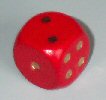
|
|
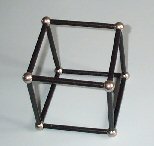
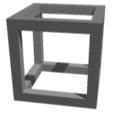
Model of a cubeThis model (right) was made from a kit with magnetic connections. Since it just shows the edges, you can see through the model, which means that you can count the vertices and edges easier. How many vertices (corners) and edges are there? See Euler's formula. I'm sorry if the model is a little wobbly. Squares don't make stable shapes, unlike triangles. |
To make a net of a cube, first look at one, such as a dice. How many faces does it have? Six, so make sure that your net has six squares. Now you must work out a way to arrange six squares so they will fold up into a cube. There are eleven different ways to do this, apart from rotations (turn it round) and reflections (turn it over). See if you can find them all below. The correct nets will change colour as you click on them. Click on New go for another go.
The easiest way to find a net is to think of a cube as four sides, a top and a bottom. Arrange four squares in a line. These are the sides. Now put the top square on one side of this line, and the bottom on the other. It doesn't really matter where on each side, they all work. There are 6 possible arrangements (apart from rotations and reflections). There are other layouts which work, but you need to think about them. Arrange three squares around a point. These will form a vertex (or corner). Arrange another three similarly. These will form the opposite vertex. Now lay one group alongside the other. There are 3 of these arrangements. The last 2 arrangements are harder to see. One is two lines of three, staggered. Both rows forms U-shapes, which fit into each other. The last arrangement is a T-shape, which forms an empty box, and one more square to make the top.

|
Net of a cube and how to make the cubeOnce you have chosen a net design, you need to draw it out. Here is one of them as an example. You can choose another net from above. Scale it up to the size you want, and put a tab on every other edge for gluing it together. It's certainly possible to make a cube from ordinary paper, but it will be fragile. Don't sit on it by mistake! You can also use thin card. How about recycling packaging such as breakfast cereal packs? Draw out the design (if you haven't printed it) and cut it out carefully, using scissors that aren't blunt or covered with glue. Before gluing, it is important to fold the design, and it's easier to do this if you score the lines first. Use a ball-point pen to go over all lines in the design, including the tabs. The ball-point pen will make a mark so if you can find a ball point pen that doesn't work, that will be perfect. Press quite heavily with the point of the pen, but don't tear the paper. Now fold the paper to make right angles, and you will see the cube start to appear. It doesn't matter which way you fold the design. Once you have scored the edges with the ball-point pen, you will find it easy to fold it either way. Use small dabs of glue to stick it, or it will end up very messy. |
If the sides of a cube are length a, then the volume is a3 or a times a times a.
 |
Some cubic packaging is made of a single piece of card with some clever folding and gluing. Roll the paper or card into a cylinder and glue the edge to keep it like that. | |
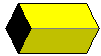 |
Put four folds in length-wise to make a rectangular cross-section to the cylinder. | |
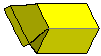 |
Pinch one end and glue it across. Pinch a fold across to give it a sharp edge. | |
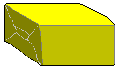
| Do the same to the other end. The corners of the ends will stick out. Fold them inwards. To open the carton, you unfold one end and snip a corner. |
In fact, most food packages are cuboids rather than cubes.
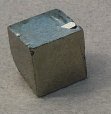
Cubic crystalIt's easy to think of a cube as a very man-made shape, and that there are no cubes in nature. Well, you'd be wrong! On the left is a pyrite crystal. It is natural, not shaped by man, and it is definitely a cube. You might think that crystals are transparent and jewel-like, but there are many metallic crystals. You can see a mini-crystal starting to grow on the top at a different angle. |
|
|
Moving cubeClick on Move or Backwards to make cube move and Stop to stop it.
|
© Jo Edkins 2007 - Return to Solids index