
 Puzzle maze stories
The Minotaur was a monster, half man, half bull, who ate men. King Minos of Crete told Daedalus, the inventor, to build a house that was so complicated that the Minotaur would never escape from it, so Daedalus built the Labyrinth. King Minos had a vast empire, and as a tribute he demanded people sent to to feed to the Minotaur. They were driven into the Labyrinth, and wandered around, lost, until the Minotaur found them. Part of King Minos' empire was Athens, in Greece. The son of the king of Athens was Theseus, a hero. He was so angry that Athenian people were being killed in this way that he volunteered to go. In Crete, Ariadne, the daughter of King Minos, fell in love with Theseus, and told him how to find his way through the Labyrinth. She gave him a thread, with one end tied to the door of the Labyrinth. Theseus could unwind the thread as he tried to find the Minotaur. When he wish to return, he could follow the thread back again, rewinding it as he went. Ariadne also gave Theseus a sword. He went in, found the Minortaur and killed him. Then he returned, and fled from Crete with Ariadne and the rest of the Athenians.
This story has been connected with unicursal mazes. A Cretan coin has the Classical pattern on it, and Roman mazes sometimes have the Minotaur in the centre. However the original Labyrinth, if it ever existed, was not a unicursal maze. Theseus needed a thread to help him retrieve his path after he had killed the Minotaur, so the Labyrinth must have been a branching maze. This myth was not only the original Labyrinth (the name of the Minotaur's prison), it also explains the derivation of the word clue. A clue helps you solve a mystery, and it is derived from the word for thread. Theseus needed the thread to solve the maze.

The picture above comes from a 5C vase, showing Theseus dragging the Minotaur through the entrance of the Labyrinth. The maze itself is represented by the Greek keys to the right, and possibly all round the pattern!
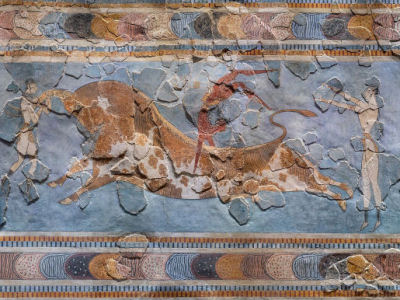
There is some historical foundation for this myth, surprisingly enough. There was a Cretan empire in the Mediterranean which included mainland Greece. It is called Minoan, after King Minos. There is a magnificent palace at Knossos. The archaeologists couldn't find a Minotaur, but they did find the palace itself very confusing, with many rooms, some at different levels, so it was easy to get lost. Perhaps ancient Greeks visiting Knossos told those at home about their experience, and this gradually changed into the story of the Labyrinth. And the Minotaur? Well, the Minoans loved bulls, and there is a fresco on the wall of the palace, showing an extraordinary display of acrobats jumping over a bull. This must have been incredibly dangerous, and no doubt people did get killed by the bull.
In 1350, Higden, monk of Chester wrote "Rosamund was the fayre daughter of Walter, Lord Clifford, concubine of Henry II, and poisoned by Queen Eleanor, AD 1177. Henry made for her a house of wonderful working, so that no man or woman might come to her. This house was named Labyrinthus, and was wrought like upon a knot in a garden called a maze. But the queen came to her by a clue of a thredde, and so dealt with her that she lived not long after." There is no reference to this particular maze earlier.
This account is a little garbled. "A knot in a garden called a maze" is unicursal, and wouldn't hide anyone. Also the "clue of a thread" doesn't help you find the centre, it helps you get out again.
Pliny (died A.D. 79) mentions labyrinths in his Natural History. He describes the Cretan labyrinth: "containing passages that wind, advance and retreat in a bewilderingly intricate manner. It is not just a narrow strip of ground comprising many miles 'walks' or 'rides,' such as we see exemplified in our tessellated floors or in the ceremonial game played by our boys in the Campus Martius but doors are let into the walls at frequent intervals to suggest deceptively the way ahead and to force the visitor to go back upon the very same tracks that he has already followed in his wanderings." That is a very interesting distinction between unicursal mazes "in our tessellated floors" and branching mazes, which "force the visitor to go back upon the very same tracks that he has already followed in his wanderings."
© Jo Edkins 2025 - Return to Patterns index