
 Information about Stourbridge Fair
This is not a walk. The first river walk takes you to Stourbridge Common. Stourbridge Fair used to be held on the common. Here is some information about the fair. There was too much to put on the first river walk webpage, so I have put it here, on a separate page.
 |
Description of Stourbridge FairStourbridge Fair was a large medieval fair. At one time it was supposed to be the largest trade fair in Europe. It started in 1199, when King John granted the Leper Chapel at Steresbrigge (Stourbridge) in Cambridge dispensation to hold a three-day fair to raise money to support the lepers. See left for a photo of the Leper Chapel, and click here for more information on the Leper Chapel. The first such fair was held in 1211 around the Feast of the Holy Cross (14 September) on the open land of Stourbridge Common by the River Cam. Despite being close Cambridge, the charter prohibited anyone from imposing taxes on the commerce there. Cambridge was a port at the time, as boats could travel from the North Sea, via the Wash, right up to Cambridge, but no further. So the fair was accessible to a large number of merchants and buyers. Later, Daniel Defoe describes how it was a major market for hops, as much beer was brewed in the north, yet hops were mostly grown in Kent and Surry. Stourbridge Fair could be reached by people from both areas. During its history the fair was variously spelled Stir-Bitch, Stirbitch and Sturbridge, with its name derived from the Steer Bridge (i.e. a bridge for oxen), where the road to Newmarket crosses a small river that enters the Cam just to the east of the common. |
In the late thirteenth century the leper colony closed, and the fair was handed over to the town of Cambridge. As the annual fair became more successful still, the right to control it became the subject of a battle between the town of Cambridge and its well-established University until in 1589 Elizabeth I confirmed the right of the town to collect the fair's profit, but controversially granted the University the right to oversee the organisation of the fair, as well as controlling quality. The cry in Stourbridge Fair - a proclamation at the start of the fair - shows some of the regulations which were enforced. Originally running for only two days, by 1589 the fair lasted from August 24 to September 29, with the 1589 charter stating that it "far surpassed the greatest of and most celebrated fairs of all England; whence great benefits had resulted to the merchants of the whole kingdom, who resorted thereto, and there quickly sold their wares and merchandises to purchasers coming from all parts of the Realm". Holding the fair in September allowed farmers to sell goods in the quiet period between harvest and ploughing, and the fact that it was out of term time meant that University tradesmen could also participate.
|
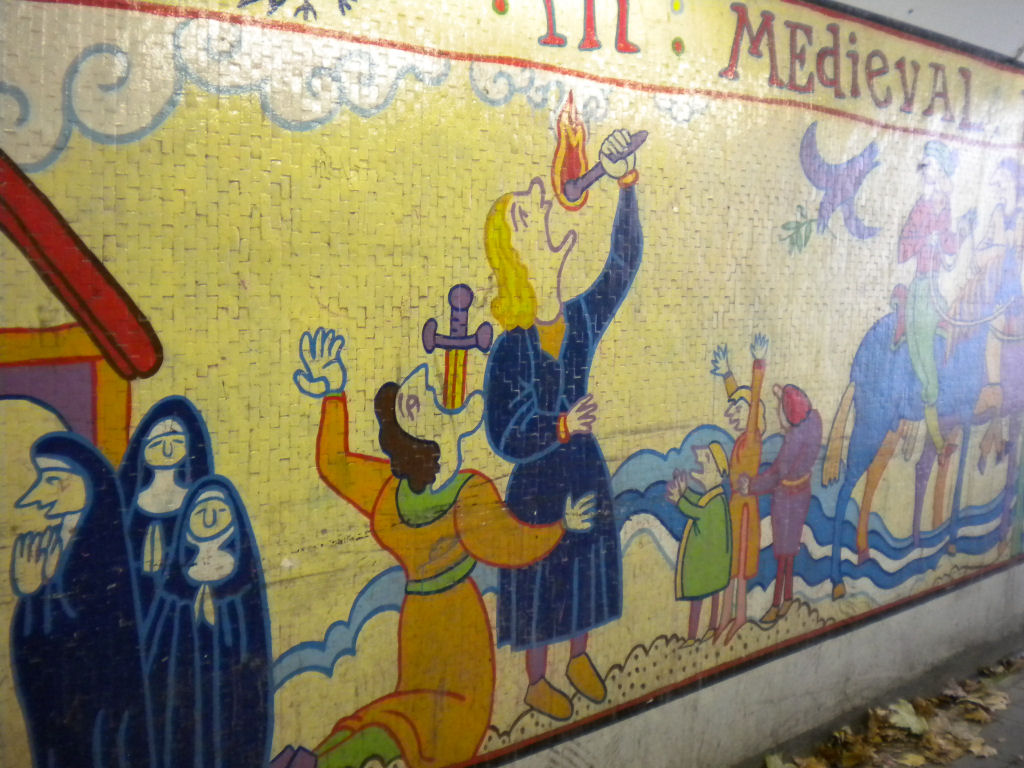
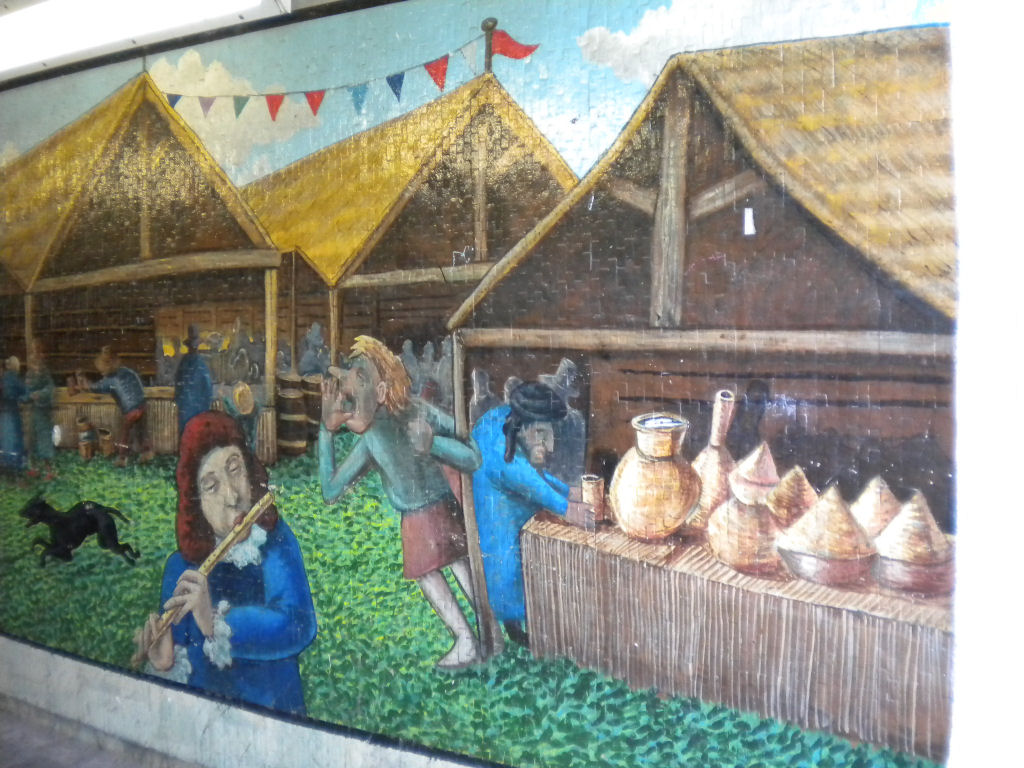
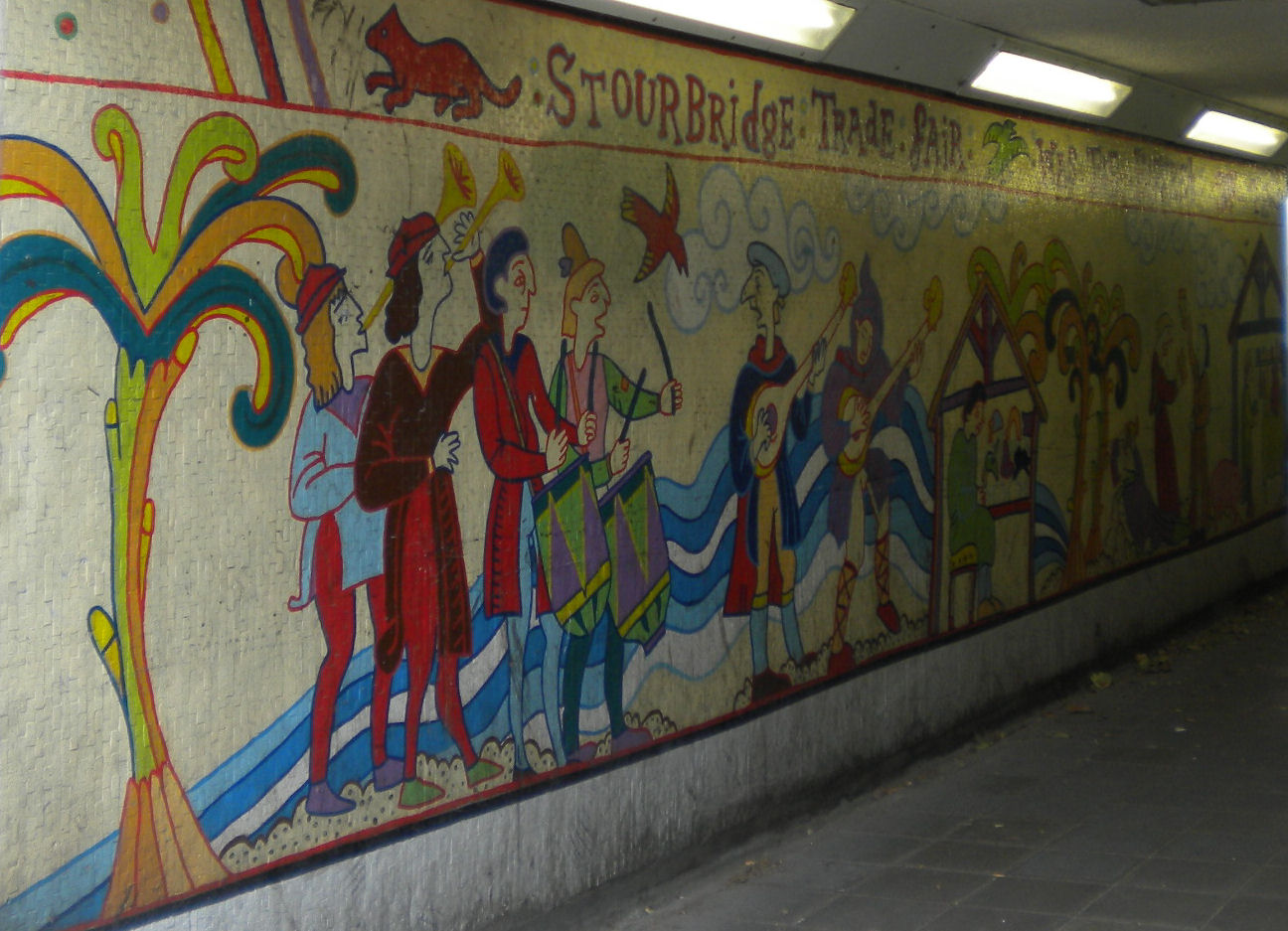
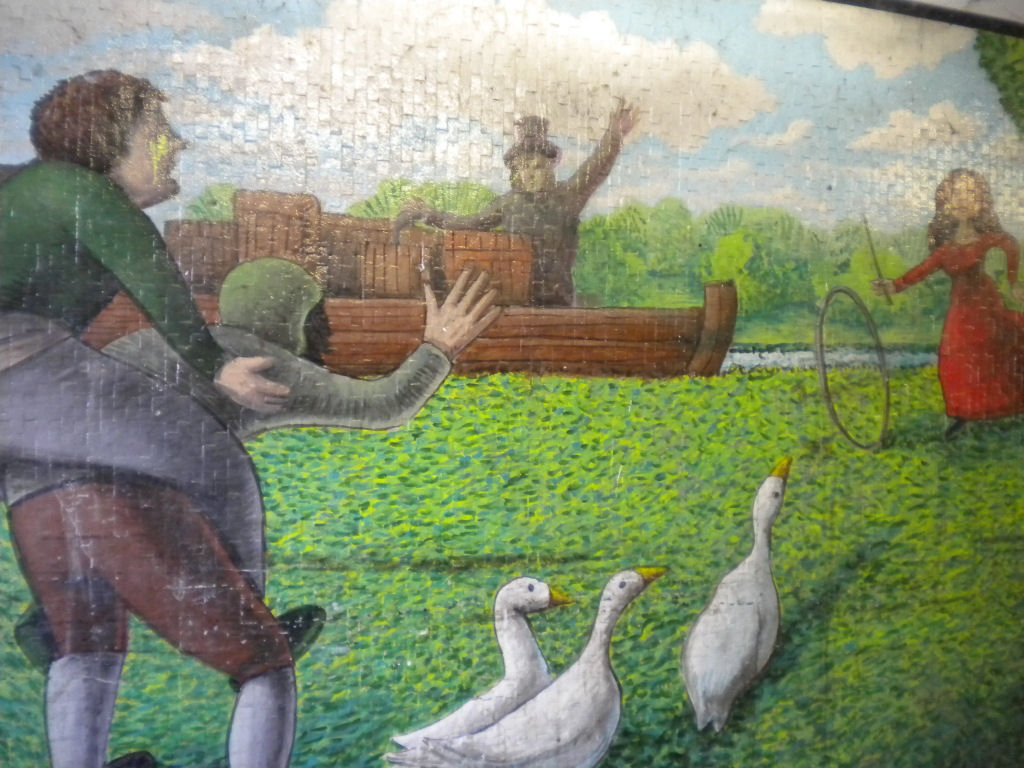
Isaac Newton visited the fair in 1665 while he was at Cambridge University. He bought a copy of Euclid's Elements which he used to teach himself mathematics. He also bought a prism here so he could start his scientific experiments which showed that white light could be split into a rainbow of colours. John Bunyan used Stourbridge Fair as the inspiration for the Vanity Fair in Pilgrim's Progress, published in 1678. The fair started to decline in the late eighteenth century, partly due to the arrival of canals and improved roads leading to the decline in the importance of rivers as a means of navigation. By the nineteenth century, the fair served more as a means of entertainment than being of economic importance, and was now only a few days in length. The Midsummer Fair was in a more convenient central location, and this took over as the main fair, and still happens today. The last Stourbridge Fair was held in 1933. It was opened by the Mayor of Cambridge "in the presence of a couple of women with babies in their arms and an ice-cream barrow." There is now a small re-enactment in September at the Leper Chapel (see below). There are also some murals about Stourbridge Fair in the Elizabeth Way underpass. Photos of these murals illustrate this page. |
 The Cry |
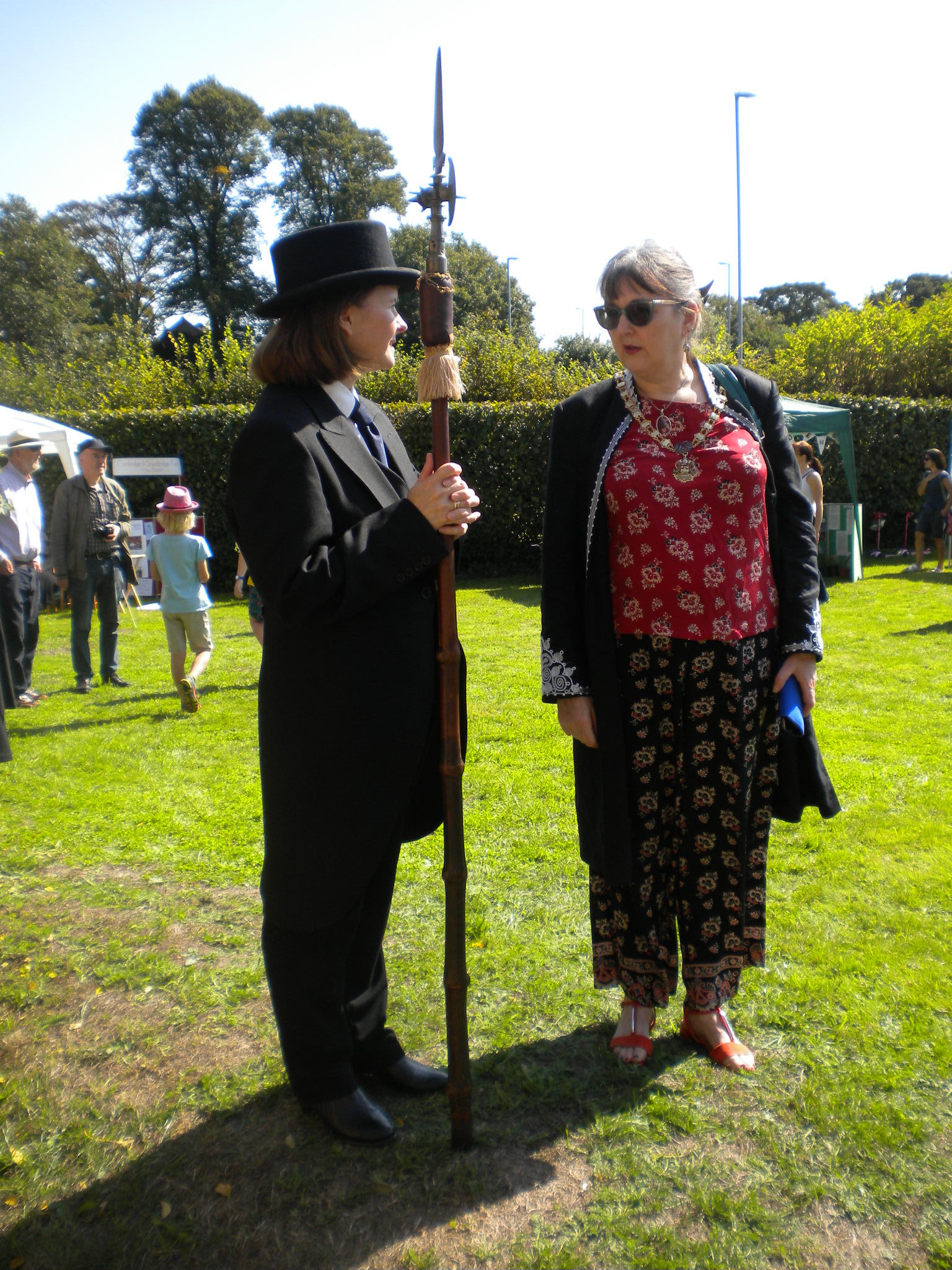 A bulldog talking to the Mayoress |
 Demonstrating equipment |
 |
The cry in Stourbridge FairAt the start of the fair, the Cry explained the rules governing the fair. This Cry is about 1506 or 1514/15. Spelling and punctuation has been modernised. The links take you to another of my websites to explain what the different units mean. The photo on the left shows the modern proclamation of the Cry at the re-enactment of the Fair. We charge & strictly command in the name of the King of England our Sovereiqn Lord & in the name of my Lord Chancellor of the University of Cambridge that all manner of scholars, scholars' servants & all other persons in this fair and the precincts of the same keep the King's peace & make no fray, cry, awtasse, freaking or any other noise by the which insurrections, conventicles, or gathering of people may be made in this fair to the trouble, vexing and disquieting of the King's liege people or letting of the officers of the University to exercise their offices under the pain of imprisonment & further punishment as the offence shall require. Also we charge and command that all manner of Scholars and Scholars' servants wear no weapon to make any fray upon any of the King's people neither in coming nor in going from this fair under the pain of banishment. |
|
Also we require and command that all manner of strangers that come to this fair, that they leave their weapon at their inns that the King's peace may be the better kept and for the occasion ensuing of the same, under the pain of forfeiting of their weapons, and for their punishment as the offence shall require. And that every innkeeper give that warning to his guests at their first coming: to leave their Weapons in their inns under the pain of punishment. Also we charge and command that all common women and misbehaving people avoid and withdraw themselves out of this fair and the precincts of the same immediately after this cry, that the King's subjects may be the more quiet, and good rule may be the better maintained, under the pain of imprisonment. Also we charge and command in the King's name of England, and in the name of my Lord Chancellor of the University, that all manner of bakers that bake to sell that they bake 2 loaves for one penny and a farthing for another of good paste, good boulted and lawful size after as grain goeth in the market. And every baker that baketh to sell have a mark upon his bread whereby it may be known who did bake it under the pain of forfeiture of his bread. Also that all bakers shall obtain and keep such sizes of bread as shall be given them by the officers of the university under the pain of forfeiture of their bread if it hap any baker to be found faulty in any article pertaining to unlawful bread according to the King's laws, that then such bakers after three monitions shall be imprisoned and punished according the laws of our Sovereign Lord the King. |
|

|
Also that no brewers sell into this fair nor anywhere within the precincts of the university, a barrel of good ale above two shillings, nor a barrel of hostel ale above twelve pence, no long ale, no red ale, no ropey ale, but good and wholesome ale for man's body under the pain of forfeiture, and that every brewer, have a mark upon his barrel whereby it may be known whose it is under the pain of imprisonment and fine at the discretion of the officers of the university. Also that every barrel of good ale hold and contain fourteen gallons, thirteen gallons of clear ale and one gallon for the rest and the hogget seven gallons that is to say six gallons and one pottle Of clear ale and the residue of rest under the pain of forfeiture and for the punishment after the discretion of the officers of the university. Also we command that the beer brewers shall sell a kilderkin of double beer in this fair for two shillings and a kilderkin of single beer for twelve pence. Also that no tipper nor gannaker sell in the said fair, nor within the precincts of the university, a gallon of good ale above four pence nor a gallon of hostel ale above two pence, And the beer brewers a gallon above four pence and a gallon of single beer above two pence under the pain of twelve pence for every time. |
Also where great detriments, hurts and deceits hath been to the King's subjects in times past by reason of false and unlawful measures brought by potters and other persons to be sold and bought in this fair and the precincts of the same in avoiding therefore the said hurts and untrue measures, we strictly charge and command that every potter and all other persons that bring such pots to be sold in this fair or precincts of the same that they and all other from henceforth sell and buy true goods and lawful measures as gallons, pottles, quarts, and half pints under the pain of imprisonment, and there to remain till they have made fine at the will of the said officers.
Also if any brewer or beer-brewer be found faulty in any of the premises after that they have been in times amerced, then the said brewer shall be committed to prison, there to remain till he have fined at the pleasure of the officers of the university.
Also that every tippler and gannaker that selleth ale in this fair that ye have the measure well and lawfully sealed and assized according to the standard of the university, and that every gannaker and beer-brewer that hath beer to sell have a sign at the booth whereby they may the better be known under the peril of imprisonment.
Also that any vintner that hath wine to sell in this fair as white wine, red wine, claret wine, gascon, malmsey, or any other wine, that they sell no dearer than they do in London except an halfpenny in a gallon toward the carriage, and that every vintner have their pots and their measures sized & ensealed after the standard of the university under tbe pain of forfeiture & their bodies to prison.
|
Also that all persons that bringeth ling-fish, stockfish or any other salt-fish to sell in this fair or within the precincts of the same that they sell no rot fish, no brynt fish, no resty fish, but good lawful and wholesome for man's body under the pain of forfeiture of their fish and their bodies to prison. Also that all manner of persons which hath salmon, herring or eels to sell in this fair that the vessels called butt, barrel, half barrel, and firkins, they sell none of them afore they be seen and searched and that the butt hold and contain eighty-three gallons, well and truly packed upon pain for every butt, barrel, half barrel so lacking their said measure six shillings and eight pence And that the great salmon be well and truly packed by itself without any meddling of any grills or broken bellied salmon with the same & that all small fish called grills be packed by them self only without any meddling upon pain of forfeiture and lofting of six shillings and eight pence for every butt, barrel and half barrel so found faulty contrary to the statute of the parliament in the which statute these points and other more be more plainly expressed. Also that any pikemonger that bringeth fresh fish to sell in the fair, as pike, tench, roach, perch, eel or any other fresh fish that the fish be quick and liveish and of size and bigness according to the statute thereof made under the pain of forfeiture and their bodies to prison. |

|

|
Also that every butcher that bringeth flesh to sell in this fair that he bringeth no rotten flesh, no murrain, no sussners, but lawful and wholesome for man's body and that every butcher bringeth the hide and the tallow of all such flesh as he shall kill to sell in this fair And that every butcher bringeth with him the liver and the lounds Of all such beasts under the pain of forfeiture. Also that every baker that baketh horsebread to sell, that he selleth three loaves for a penny after good and lawful size and after such size as shall be given them, by the university, and that it be made of good peas & beans & other lawful stuff, upon the pain aforesaid. Also that all brown bakers, as well as innkeepers as other, observe and keep such size of horsebread as shall be given them by the said officers, under the pains and punishments as of other bakers is rehearsed. Also that all persons that selleth by measure as by ell or by yard woollen cloth or linen cloth, silk, worsteads sized and ensealed that they have their ells and their yards sized and ensealed after the standard of the university under the pain of forfeiture and their bodies to prison. Also that all persons that selleth by measure as by bushel, half bushel, peck or half peck as coal, salt, mustard seed or any other thing that their bushels, half bushels and pecks be sized and sealed after the standard of the university under the pain of imprisonment and more punishment as the offence shall require. |
Also that all persons that selleth by weight have good and lawful weights sized and ensealed and to agree with the standard weights of the university under the pain of imprisonment and for their fine as it shall please the officers of the university.
Also that no man shall regrate none of the foresaid things as ling fish, salt fish, stock fish, herring, salmon, pike, tench, wax, flax, osmund, rosin, yarn, pitch, tar, cloth, nor none other thing of grocery ware or any other merchandise in this fair under the gain of forfeiture and their bodies to prison & to make fine as it shall please the officers of the university. And he regrateth that buyeth any of the said things afore rehearsed or any other manner of merchandise of any man in this fair and selleth again the same thing in the said fair enhancing the price of the said thing more that it was before.
|
Also if there be any person that will sue by personal action either for debt, victuals, injury and trespass or think themselves wronged in any of the premises or otherwise, let him come and complain to my Lord Chancellor's Commissary and other officers of the university which shall hold and keep courts daily and hourly in this fair during the same to the intent that he shall be heard with lawful favour, right and conscience and after the liberties of the same. Also that every butcher that bringeth flesh to sell in this market that they bring no rotten flesh &c, ut supra. Also that every butcher that bringeth to sell in this market that they sell none of the tallow of all such beasts as they shall bring to sell in this market, but to such Rasment and tallow-candellers as are dwellers within the said university and precincts of the same, & they to make the said tallow in good and lawful candle so that the said university and town of Cambridge be nowise disappointed but the better served and that they sell not a pound of candle above a penny, and that the said butcher sell not a stone of tallow above eight pence. Also that every innkeeper that keepeth inn that he have his bottles of hay well and lawfully made and sized and that every bottle weigh seven pound & that they sell not less than three horse loaves good and lawful for a penny under the pain of punishment after the discretion of the officers of the university. Also that every carrier that bringeth wood to sell in this market that they bring good wood, and if it be faggot let the faggot thereof be well filled and sized & that every faggot be full seven foot long and every faggot to have two bounds & thirty-one faggots in a load well filled after the said length under the pain of forfeiture. |

|
Also that every collier that bringeth charcoal to sell that every sack called a quarter sack holds eight bushels, saving that they be allowed for the culm and breaking by the way after the discretion of the officers of the university under pain of forfeiture.
Also that every person that bringeth grain to sell in the market that they open not afore ten of the clock nor to stand after one of the clock under the pain of forfeiture.
This is from "The Ceremonies Observed in the Senate-House of the University of Cambridge", written by Adam Wall in 1798 and re-edited by Henry Gunning in 1828.

It says ""The Vice-Chancellor and the company meeet in the Senate-House at eleven. When the date of the year is an uneven number, they meet rather earlier, as in that case the University proclaims before the Corporation." That suggests that the City had their own Cry. That is supported by a complaint in 1533, that the proctors "make proclamation in the same fayre before the proclamation of the Mayre of Cambryge, Wyche Mayre ys lord of the said fayre." They replied that they "may so lawfully do as by the Kynges letters patents as conservators of the peace and having thority of vytalls which are fyrst sold wythin the fayre." The Cry above (which is the University one) is certainly talking about keeping the peace, and quality of food and drink.
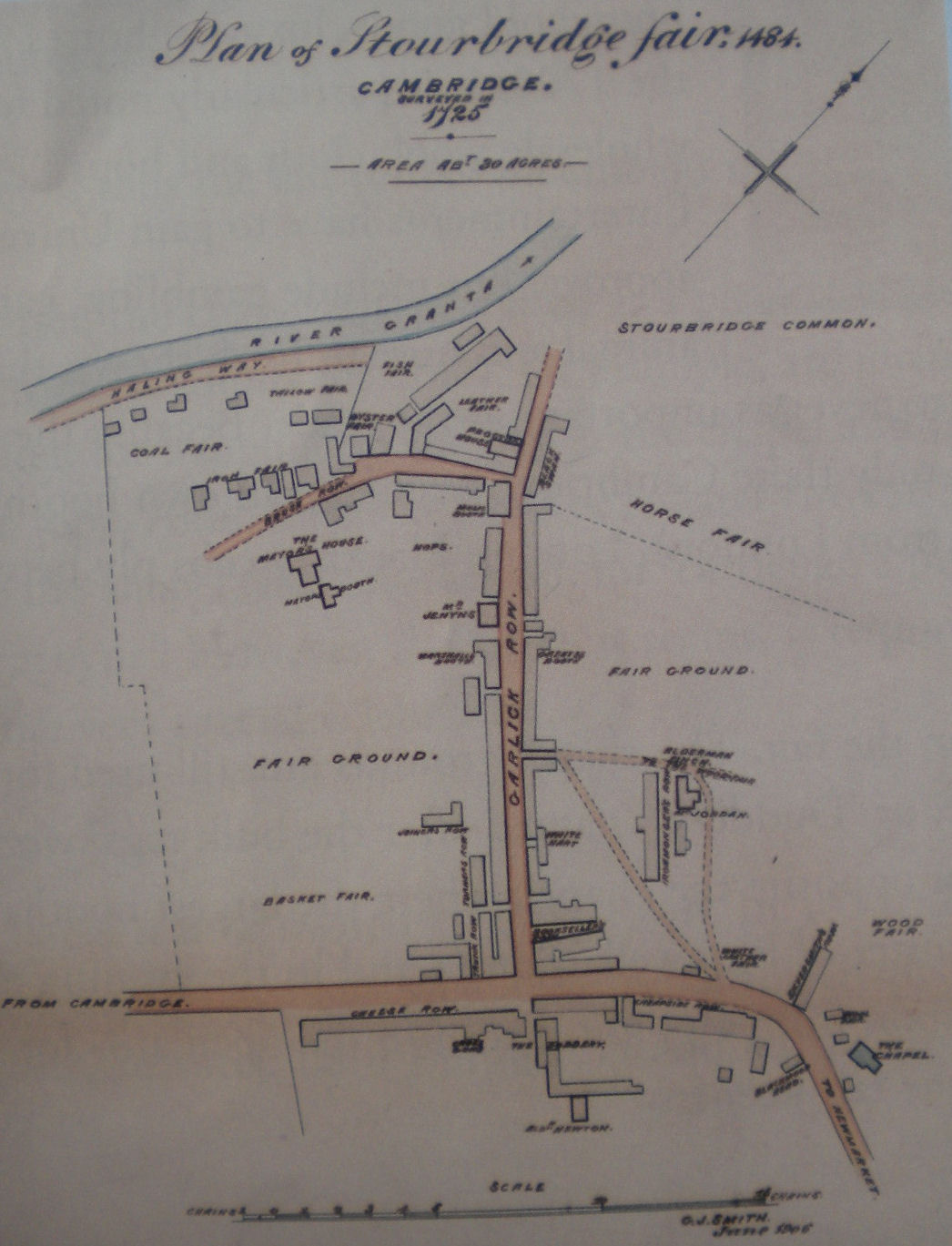
| Plans of Stourbridge Fair 1725 | Modern map for comparison | |
|---|---|---|
 |
 |
 |
Please note that North is not at the top of the maps. The plan twisted the map round to fit the river and Newmarket Road into a neat square, and I have done the same to the modern map so you can compare them. The main road in the plan is Garlic Row, and this roads still exists today. Below, Daniel Defoe seems to suggest that in his time it was called Cheapside. The modern Oyster Row seems to appear on the early plan, although here it is called Brush Row.
I now draw near to Cambridge, to which I fancy I look as if I was afraid to come, having made so many circumlocutions beforehand; but I must yet make another digression before I enter the town (for in my way, and as I came in from Newmarket, about the beginning of September), I cannot omit, that I came necessarily through Stourbridge Fair, which was then in its height.
If it is a diversion worthy a book to treat of trifles, such as the gaiety of Bury Fair, it cannot be very unpleasant, especially to the trading part of the world, to say something of this fair, which is not only the greatest in the whole nation, but in the world; nor, if I may believe those who have seen the mall, is the fair at Leipzig in Saxony, the mart at Frankfort-on-the-Main, or the fairs at Nuremberg, or Augsburg, any way to compare to this fair at Stourbridge.
It is kept in a large corn-field, near Casterton, extending from the side of the river Cam, towards the road, for about half a mile square.
|
If the husbandmen who rent the land, do not get their corn off
before a certain day in August, the fair-keepers may trample it
under foot and spoil it to build their booths, or tents, for all
the fair is kept in tents and booths. On the other hand, to
balance that severity, if the fair-keepers have not done their
business of the fair, and removed and cleared the field by another
certain day in September, the ploughmen may come in again, with
plough and cart, and overthrow all, and trample into the dirt; and
as for the filth, dung, straw, etc. necessarily left by the fair-
keepers, the quantity of which is very great, it is the farmers'
fees, and makes them full amends for the trampling, riding, and
carting upon, and hardening the ground.
It is impossible to describe all the parts and circumstances of this fair exactly; the shops are placed in rows like streets, whereof one is called Cheapside; and here, as in several other streets, are all sorts of trades, who sell by retail, and who come principally from London with their goods; scarce any trades are omitted--goldsmiths, toyshops, brasiers, turners, milliners, haberdashers, hatters, mercers, drapers, pewterers, china- warehouses, and in a word all trades that can be named in London; with coffee-houses, taverns, brandy-shops, and eating-houses, innumerable, and all in tents, and booths, as above. This great street reaches from the road, which as I said goes from Cambridge to Newmarket, turning short out of it to the right towards the river, and holds in a line near half a mile quite down to the river-side: in another street parallel with the road are like rows of booths, but larger, and more intermingled with wholesale dealers; and one side, passing out of this last street to the left hand, is a formal great square, formed by the largest booths, built in that form, and which they call the Duddery; whence the name is derived, and what its signification is, I could never yet learn, though I made all possible search into it. The area of this square is about 80 to 100 yards, where the dealers have room before every booth to take down, and open their packs, and to bring in waggons to load and unload. |
|
|
This place is separated, and peculiar to the wholesale dealers in the woollen manufacture. Here the booths or tents are of a vast extent, have different apartments, and the quantities of goods they bring are so great, that the insides of them look like another Blackwell Hall, being as vast warehouses piled up with goods to the top. In this Duddery, as I have been informed, there have been sold one hundred thousand pounds worth of woollen manufactures in less than a week's time, besides the prodigious trade carried on here, by wholesale men, from London, and all parts of England, who transact their business wholly in their pocket-books, and meeting their chapmen from all parts, make up their accounts, receive money chiefly in bills, and take orders: These they say exceed by far the sales of goods actually brought to the fair, and delivered in kind; it being frequent for the London wholesale men to carry back orders from their dealers for ten thousand pounds' worth of goods a man, and some much more. This especially respects those people, who deal in heavy goods, as wholesale grocers, salters, brasiers, iron-merchants, wine-merchants, and the like; but does not exclude the dealers in woollen manufactures, and especially in mercery goods of all sorts, the dealers in which generally manage their business in this manner. Here are clothiers from Halifax, Leeds, Wakefield and Huddersfield in Yorkshire, and from Rochdale, Bury, etc., in Lancashire, with vast quantities of Yorkshire cloths, kerseys, pennistons, cottons, etc., with all sorts of Manchester ware, fustiains, and things made of cotton wool; of which the quantity is so great, that they told me there were near a thousand horse-packs of such goods from that side of the country, and these took up a side and half of the Duddery at least; also a part of a street of booths were taken up with upholsterer's ware, such as tickings, sackings, kidderminster stuffs, blankets, rugs, quilts, etc. |
|
In the Duddery I saw one warehouse, or booth with six apartments in it, all belonging to a dealer in Norwich stuffs only, and who, they said, had there above twenty thousand pounds value in those goods, and no other. Western goods had their share here also, and several booths were filled as full with serges, duroys, druggets, shalloons, cantaloons, Devonshire kerseys, etc., from Exeter, Taunton, Bristol, and other parts west, and some from London also. But all this is still outdone at least in show, by two articles, which are the peculiars of this fair, and do not begin till the other part of the fair, that is to say for the woollen manufacture begins to draw to a close. These are the wool and the hops; as for the hops, there is scarce any price fixed for hops in England, till they know how they sell at Stourbridge fair; the quantity that appears in the fair is indeed prodigious, and they, as it were, possess a large part of the field on which the fair is kept to themselves; they are brought directly from Chelmsford in Essex, from Canterbury and Maidstone in Kent, and from Farnham in Surrey, besides what are brought from London, the growth of those and other places. Enquiring why this fair should be thus, of all other places in England, the centre of that trade; and so great a quantity of so bulky a commodity be carried thither so far; I was answered by one thoroughly acquainted with that matter thus: the hops, said he, for this part of England, grow principally in the two counties of Surrey and Kent, with an exception only to the town of Chelmsford in Essex, and there are very few planted anywhere else. |

|
There are indeed in the west of England some quantities growing: as at Wilton, near Salisbury; at Hereford and Broomsgrove, near Wales, and the like; but the quantity is inconsiderable, and the places remote, so that none of them come to London.

|
As to the north of England, they formerly used but few hops there, their drink being chiefly pale smooth ale, which required no hops, and consequently they planted no hops in all that part of England, north of the Trent; nor did I ever see one acre of hop-ground planted beyond Trent in my observation; but as for some years past, they not only brew great quantities of beer in the north, but also use hops in the brewing their ale much more than they did before; so they all come south of Trent to buy their hops; and here being quantities brought, it is great part of their back carriage into Yorkshire, and Northamptonshire, Derbyshire, Lancashire, and all these counties; nay, of late, since the Union, even to Scotland itself; for I must not omit here also to mention, that the river Grant, or Cam, which runs close by the north-west side of the fair in its way from Cambridge to Ely, is navigable, and that by this means, all heavy goods are brought even to the fair-field, by water carriage from London and other parts; first to the port of Lynn, and then in barges up the Ouse, from the Ouse into the Cam, and so, as I say, to the very edge of the fair. In like manner great quantities of heavy goods, and the hops among the rest, are sent from the fair to Lynn by water, and shipped there for the Humber, to Hull, York, etc., and for Newcastle-upon- Tyne, and by Newcastle, even to Scotland itself. Now as there is still no planting of hops in the north, though a great consumption, and the consumption increasing daily, this, says my friend, is one reason why at Stourbridge fair there is so great a demand for the hops. He added, that besides this, there were very few hops, if any worth naming, growing in all the counties even on this side Trent, which were above forty miles from London; those counties depending on Stourbridge fair for their supply, so the counties of Suffolk, Norfolk, Cambridge, Huntingdon, Northampton, Lincoln, Leicester, Rutland, and even to Stafford, Warwick, and Worcestershire, bought most if not all of their hops at Stourbridge fair. |
These are the reasons why so great a quantity of hops are seen at this fair, as that it is incredible, considering, too, how remote from this fair the growth of them is as above.
This is likewise a testimony of the prodigious resort of the trading people of all parts of England to this fair; the quantity of hops that have been sold at one of these fairs is diversely reported, and some affirm it to be so great, that I dare not copy after them; but without doubt it is a surprising account, especially in a cheap year.
The next article brought thither is wool, and this of several sorts, but principally fleece wool, out of Lincolnshire, where the longest staple is found; the sheep of those countries being of the largest breed.
|
The buyers of this wool are chiefly indeed the manufacturers of Norfolk and Suffolk and Essex, and it is a prodigious quantity they buy. Here I saw what I have not observed in any other county of England, namely, a pocket of wool. This seems to be first called so in mockery, this pocket being so big, that it loads a whole waggon, and reaches beyond the most extreme parts of it hanging over both before and behind, and these ordinarily weigh a ton or twenty-five hundredweight of wool, all in one bag. The quantity of wool only, which has been sold at this place at one fair, has been said to amount to fifty or sixty thousand pounds in value, some say a great deal more. By these articles a stranger may make some guess at the immense trade carried on at this place; what prodigious quantities of goods are bought and sold here, and what a confluence of people are seen here from all parts of England. I might go on here to speak of several other sorts of English manufactures which are brought hither to be sold; as all sorts of wrought-iron and brass-ware from Birmingham; edged tools, knives, etc., from Sheffield; glass wares and stockings from Nottingham and Leicester; and an infinite throng of other things of smaller value every morning. |
|

|
To attend this fair, and the prodigious conflux of people which come to it, there are sometimes no less than fifty hackney coaches which come from London, and ply night and morning to carry the people to and from Cambridge; for there the gross of the people lodge; nay, which is still more strange, there are wherries brought from London on waggons to ply upon the little river Cam, and to row people up and down from the town, and from the fair as occasion presents. It is not to be wondered at, if the town of Cambridge cannot receive, or entertain the numbers of people that come to this fair; not Cambridge only, but all the towns round are full; nay, the very barns and stables are turned into inns, and made as fit as they can to lodge the meaner sort of people: as for the people in the fair, they all universally eat, drink, and sleep in their booths and tents; and the said booths are so intermingled with taverns, coffee-houses, drinking-houses, eating-houses, cook-shops, etc., and all in tents too; and so many butchers and higglers from all the neighbouring counties come into the fair every morning with beef, mutton, fowls, butter, bread, cheese, eggs, and such things, and go with them from tent to tent, from door to door, that there is no want of any provisions of any kind, either dressed or undressed. In a word, the fair is like a well-fortified city, and there is the least disorder and confusion I believe, that can be seen anywhere with so great a concourse of people. |
|
Towards the latter end of the fair, and when the great hurry of wholesale business begins to be over, the gentry come in from all parts of the county round; and though they come for their diversion, yet it is not a little money they lay out, which generally falls to the share of the retailers, such as toy-shops, goldsmiths, braziers, ironmongers, turners, milliners, mercers, etc., and some loose coins they reserve for the puppet shows, drolls, rope-dancers, and such like, of which there is no want, though not considerable like the rest. The last day of the fair is the horse-fair, where the whole is closed with both horse and foot races, to divert the meaner sort of people only, for nothing considerable is offered of that kind. Thus ends the whole fair, and in less than a week more, there is scarce any sign left that there has been such a thing there, except by the heaps of dung and straw and other rubbish which is left behind, trod into the earth, and which is as good as a summer's fallow for dunging the land; and as I have said above, pays the husbandman well for the use of it. I should have mentioned that here is a court of justice always open, and held every day in a shed built on purpose in the fair; this is for keeping the peace, and deciding controversies in matters deriving from the business of the fair. The magistrates of the town of Cambridge are judges in this court, as being in their jurisdiction, or they holding it by special privilege: here they determine matters in a summary way, as is practised in those we call Pye Powder Courts in other places, or as a Court of Conscience; and they have a final authority without appeal. |

|
See here.
Near half a mile east of this village [Barnwell, with the church of St Andrew the Less], Sturbridge-fair is kept, which is set out annually on St Barthelomew [August 25] by the mayor, aldermen, and the rest of the corporation of Cambridge, who all ride thither in a grand procession, with music playing before them, and most of the boys in the town on horseback after them, who, as soon as the ceremony is read over, ride races about the place, when returning to Cambridge, each boy has a cake and some ale at the town-hall, but I believe the old custom is now laid aside. On the seventh of September, they ride in the same manner to proclaim it, which being done, the fair begins, and continues three weeks, though the greatest part is over in a fortnight.
This fair, which was thought some years ago, to be the greatest in Europe, is kept in a corn field, about half a mile square, having the river Cam running on the north side thereof, and the rivulet called the Stour (from which, and the bridge over it, the fair received its name) on the east side; and it is about two miles east of Cambridge market-place, where, during the fair, coaches, chaises and chariots attend to carry persons to the fair: the chief diversions at Sturbridge are drolls, rope-dancing and sometimes a music booth; but there is an act or parliament which prohibits the acting of plays within ten miles of Cambridge.
If the field (on which the fair is kept) is not clear'd of the corn by the twenty-fouth of August, the builders may trample it under foot to build their booths; and on the other hand, if the same be not cleared of the booths and other materials belonging thereto, by Michaelmas-Day at noon, the plowmen may enter the same with their horses, plows and carts, and destroy whatever they find on the premises; as for the filth, dung, straw, etc left behind by the fair-keepers, make them amends for their trampling and hardening the ground.
The shops or booths are built in rows like streets, having each their name, as garlic-Row, Booksellers-Row, Cook-row, etc. And every commodity has its proper place, as the Cheese-fair, Hop-fair, Wool-fair, etc. And here, as in several other streets or rows, are all sorts of traders who sell by wholesale or retail, as goldsmiths, toymen, brasiers, turners, milliners, haberdashers, hatters, mercers, drapers, pewterers, Chine-warehouses, and in a word, most trade that can be found in London, from whence many of them come; here are also taverns, coffee-houses, and eating-houses in great plenty, and all kept in booths, except six or seven brick houses built many years ago, and in any of which (except the coffee-booth) you may at any time be accommodated with hot or cold roast goose, roast of boiled pork, etc.
Crossing the main road, at the south end of Garlick-row, and a little on the left hand, is a great square, formed of the largest booths, called the Duddery, the area of which square is from 140 to 300 foot, chiefly taken up with woollen drapers, wholesale taylors and sellers of second-hand clothes etc, where the dealers have a room before their booths to take down and open their packs, and to bring in waggons to load and unload the same. In the centre of this square was (till within the last three years) erected a tall maypole, with a vane at the top; and in this figure, on the two chief Sundays during their fair, both forenoon and afternoon, divine service is read, and a sermon preach'd from a pulpit placed in the open air, by the minister of Barnwell, as aforesaid; who is very well paid for the same, by the contribution of the fair-keepers.
But A.D.1710, a dispute arising between the corporation of Cambridge, and the patrons of Barnwell, concerning the right of appointing a Sturbridge Fair preacher, caused the two following Advertisments to be published:
September the 11th, 11710
"Whereas Mr Mayor of Cambridge has actually this Year this year, contrary to Law, Ancient Usage and Custom, set up an Unlicens'd Preacher at Sturbridge-Fair, in Opposition to the present patron and Minister of Barnwell, who claim the Right of preaching there by Immemorial Prescription:"
"We, the Patron and Minsiter thereof, do hereby make it known, in Vindication of Our own just Rights, and those of the Future patrons and Ministers of the said Parish, That We shall deem the Person or persons, who have, or shall presume in Opposition to Us, to Preach within the said Parish-bounds, to be Intruders on Our Priviledge; and that We will use all Lawful Means to Assert and Maintain Our Title against all such Usurpers and their Abettors."
Cambr. Septemb. 10th 1711
"Whereas 'tis the Resolution of the Corporation of Cambridge, against the present Incumbent of Barnwell, to set up a preacher in Sturbridge-fair; being led thereinto, by artificially persuading some of this Predecessors into an Illegal Note, against the Patron, his Clerks and Successors in the said Living: And Sturbridge-Fair being in the parish of Little St Andrew Barnwell, and the Ministers thereof, have (when Right and law prevail'd) Time out of Mind, without any disturbance (the said Corporation of Cambridge finding alwaies a Pulpit) perform'd the Service of the two Lord's-days during the said fair, with Their Congregation, Service-books, Vestments, Pulpit-Ornaments, and parish-Clark, in Gratitude for the Collection that hath been There alwaies made, for better support of themselves under their small Parachial Income, till last Year 1710, for which intrusion Then, the Unwary Usurper was censured in the Bishop's Ecclesiastical Court. These do humbly give Notice, to the Gentlemen of the fair, that the Pulpit not being allow'd this Year as usual, and it not being known soon enough to provide one, the Service of the next Lord's-day, during this present fair, will be perform'd in the Parish-Church, Morning and Evening, by the Minister of Barnwell." Will. Piers.
In this duddery only, it is said, there have been sold 100,000l. worth of woollen manufactures in less than a week's time, besides the prodigious trade carried on here by the wholesale taylors from London and most parts of England; who transact their business wholly in their pocket books, and meeting here their chapmen from all parts, make up their accounts, receive money chiefly in bills, and take further orders. These, they say, exceed by far the sale of goods actually brought to the fair, and delivered in kind; it being frequent for the London wholesalemen to carry back orders from their dealers, for 10,000l. worth of goods a man, and some much more. And once in this duddery, it is said, there was a Booth consisting of six apartments, all belonging to a dealer in Norwich stuffs only, who had there about 20,000l. worth of those goods.
The trade for wool, hops, and leather, here is prodigious, the quantity of wool only, sold at one fair, is said to have amounted to 50 or 60,000l. and of hops, very little less.
September 14, being the horse-fair day, is the day of the greatest hurry, when it is almost incredible to conceive what number of people there are, and the quantity of victuals that day consumed by them.
During the fair, Colchester oysters, and white herrings just come into season, are in great request, at least by such as live in the inland parts of the kingdom; where they are seldom to be had fresh, especially the later
The fair is like a well governed city, and less disorder and confusion to be seen there, than in any other place, where there is a great concourse of people: here is a court of justice always open from morning to night, where the mayor of Cambridge, or his deputy, sits as a judge; determining all controversies in matters arising from the business of the fair, and seeing the peace thereof be kept; for which purpose he has eight servants, called red-coats, attending him during the time of the fair and other public occasions, one or other of which are constantly at hand, in most parts of the fair: and if any dispute arise between buyer and seller etc, on calling out red-coat, you instantly have one or more come running to you; and if the dispute is not quickly decided, the offender is carried to the said court, where the case is determined in a summary way (as is practised in those called Pye-Powder courts, in other fairs) from which sentence there is no appeal.
About two or three days after the horse-fair, when the hurry of the wholesale business is over, the county gentlemen, for about ten or twelve miles round, begin to come in, with their sons and daughters; and tho' diversion is what chiefly brings them, yet it is not a little money they lay out among the tradesmen, toyshops etc, besides what is flung away to see the puppet shews, drolls, rope-dancing, live-creatures etc, of which there is commonly plenty.
The last observation I shall make concerning this fair is, how inconveniently a multitude of people are lodged there, who keep it; their bed (if I may so call it) is laid on two or three boards. nailed to four pieces that bears it about a foot from the ground, and four boards round it, to keep the persons and the clothes from falling off; and is about five foot long; standing abroad all day if it rains not, at night it is taken into their booths, and put into the best manner they can; at bed-time they get into it, and lay neck and heels together till the morning, if the wind and rain do not force them out sooner; for a high wind often blows down their booths, as it did AD 1741; and a heavy rain forces through the hair-cloth that cover it.
Though the corporation of Cambridge has the toils of this fair, and the government as foresaid; yet the body of the university has the oversight of the weights and measures thereof (as well as at Midsummer and Rech fairs) and the licencing of all shew-booth, live-creatures, etc. And the Proctors of the university keep a court there also, to hear complaints about weights or measures, seek out and punish lewd women, and see that their gownsmen commit no disorders.
Here was formerly an hospital for lepers, dedicated to St Mary Magdalen, the chapel of which is still standing near the Paper-mills, and is used as a victalling house in time of the fair.
Thursday 19 September 1661
Up early, and my father and I alone into the garden, and there talked about our business, and what to do therein. So after I had talked and advised with my coz Claxton, and then with my uncle by his bedside, we all horsed away to Cambridge, where my father and I, having left my wife at the Beare with my brother, went to Mr. Sedgewicke, the steward of Gravely, and there talked with him, but could get little hopes from anything that he would tell us; but at last I did give him a fee, and then he was free to tell me what I asked, which was something, though not much comfort.
From thence to our horses, and with my wife went and rode through Sturbridge but the fair was almost done. So we did not 'light there at all, but went back to Cambridge, and there at the Beare we had some herrings, we and my brother, and after dinner set out for Brampton, where we come in very good time, and found all things well, and being somewhat weary, after some talk about tomorrow's business with my father, we went to bed.
These information boards were displayed at the 2019 Stourbridge fair, sources from Cambridgeshire archives. Click on the small picture for a larger version:


This comes from here.
During its history the fair was variously spelled "Stir-Bitch", "Stirbitch", "Stirbiche" and "Sturbridge", with its name derived from the "Steer Bridge" (i.e. a bridge for oxen), where the road to Newmarket crosses a small river that enters the Cam just to the east of the common (the name "Sture" or "Stour" now given to this river is a back-formation).
An 18th century rhyme offered another explanation:
Stirbitch Fair - its name it does derive
From some poor clothiers that from thence did thrive;
As they were travelling over the Brook Stour,
Their goods fell in and wetted were all o'er;
They hung them up in order for to dry,
And people bought them fast as they past by.
Having such luck, together did agree,
That they the next year would come the same way;
Again they came, again success they found,
And 'stablish'd Stirbitch Fair upon that ground.
There were other fairs in medieval Cambridge (and later).
This is taken from here.
The Garlic Fair, was granted to the Benedictine nuns at The Cambridge Nunnery of St Mary and St Radegund was founded in 1133 by King Stephen in the mid 12th century. the Fair was held in mid August (the Christian festival of the Assumption or the pagan Lammas.) The Fair was initially held within the walls of the nunnery in what was the Nuns' Close and is now the Jesus College Master's garden. The Fair then moved along Jesus Lane to the corner of what became known as Garlic Fair Lane and is now Park Street. It continued there until its eventual demise at the beginning of the 19th century. Records show that Jesus College that had long taken over the area, got £1 in rent every year.
This is taken from here.
Until comparatively recent times, Park Street was known as Garlic Fair Lane, for here as late as 1808, was held the fair granted to the nuns of St Radegund in 1438. The remarkable name of this fair has never been satisfactorily explained. It was also called the Nuns' Fair, and originally was held in the Nuns' Close, the site of the fair-yard being approximately opposite to Manor Street.
This is taken from here.
Charter granted by Henry Vi, 1438:
The King grants to the Prioress and Nuns the right to hold an annual fair in the town of Cambridge, on the three days of the vigil, the feast and the morrow of the Assumption of Our Lady, "nisi feria illa sit ad nocumentum vicenarum feriarum" (unless the said fair should be a nuisance to neighbouring fairs). He also grants exemption from tenths or other quotas upon all the lands, possessions etc. of the Priory. Written at Dertfort (Dartford? Hertford?), witnessed by the King himself.
This fair was held quite close to Stourbridge Fair, which started at the end of August. SInce there are comments above about clearing the crops of that fair before the fair started, presumably that explains August as a popular date for fairs! You wouldn't want to leave it too late in the year, as muddy roads would make it hard for people to travel to the fair.
This is still held at Midsummer, on (naturally) Midsummer Common. A road in the Kite leading to it is called Fair Street, although I don't know how old the road (or name) is. It is now a funfair, although there are still a few market-style stalls, which is nice. The fair has a charter from King John. The fair is opened by the Mayor of Cambridge.
This is held in the village of Reach, east of Cambridge, on May Bank holiday (beginning of May). It has a traditional association with Cambridge, and is opened by the Mayor of Cambridge. He (or she) throws pennies to the crowd. CamCycle traditionally bike there from Cambridge, but I don't know how old this tradition is!
This is a modern fair, started in 1974, on Midsummer Common. It is more like a medieval fair, with plenty of stalls, and food and drink. It is often called a hippy fair!
This is a street fair held on the first Saturday in December. It started in 2005, to promote community feeling throughout Mill Road (which tends to be split into the communities either side of the railway bridge). It also wanted to promote Christmas shopping in the Mill Road shops. There are food and craft stalls at various locations, and all along the street, processions, and events based in religious sites such as the churches and the mosques. It is so popular that the street is now closed to traffic.
There are many events and fairs in Cambridge apart from these, such as fun fairs.
© Jo Edkins 2010 - Return to Walks index