
First, delete the horizontal lines.

Double these up to produce the strands.
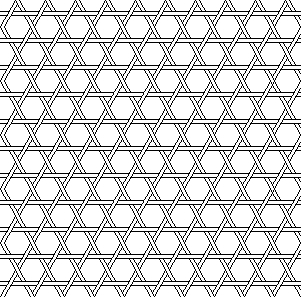
Now put the horizontal lines back, shifting them up a little, and making the under-and-overs.

 Most of the Celtic knots on this website are based on a square grid. The historic examples seem to prefer this, and I'm not surprised. It is quite easy to draw a square grid by eye, but other angles are far harder. Computers prefer square grids as well!
|
First, delete the horizontal lines. |
Double these up to produce the strands. |
Now put the horizontal lines back, shifting them up a little, and making the under-and-overs. |

 To finish the knot, tidy up the edges, and colour it in. Here I have removed the background as well.

 The previous example was a loose knot. You can tighten the knot a lot more, as in this example. On the left, I show how you can just colour in the grid to make the strands. On the right, I've removed the surplus grid lines and removed the background. I've made the different orientations as different colours, so I couldn't tidy up the edges.

 Most regular tessellations apart from squares and triangles have an odd number of numbers at each junction, which makes it impossible to make into a celtic knot. However, there is a tessellation of squares, hexagons and triangles. Here there are four lines at each junction, unlike the triangles above, so it is easier to make a knot from it. It ends up an interlocking dodecagons!