
If you wish to learn how to work a footside in detail, click here
A footside is a straight, strong edge to the lace. The strength is provided by the passives. These are one or more pairs, running parallel to the edge of the lace. The passives are worked with other pairs, but never enter or leave the lace.
The rest of the footside consists of a pair leaving the main body of the lace, crossing the passives and then the edge pair to reach the edge. A pin is put inside both of these non-passive pairs. The old edge pair crosses the passives again, to return to the lace. The number of passives, and whether the passives are worked in cloth stitch or cloth stitch and twist define the type of footside. There is another type of footside called Winkie pin, where there is no edge pairs at all - the pair from the lace crosses the passives, goes round a pin, crsses the passives again and returns to the lace. Click here for detailed descriptions of how to do the different types of footside.
These footside passives are strange. They are worked without pins. They also do not follow the normal grid of lace, but are between the usual lines of pins. This diagram shows some Torchon ground next to a footside. The pink are the passives. Three pairs from the Torchon ground are marked red, green and blue, to show how they reach the edge, stay at the edge for a bit, then return to the lace.

This diagram shows the simpler Winkie pin footside, again next to Torchon ground. It has no edge pairs. Instead a pair leaves the lace, crosses the passives, round a pin, and immediately returns to to lace.

If you are designing your own lace, then start with the relevant simple grid. Click here for a variety of grids. Decide on the right edge, which is where the footside will go.
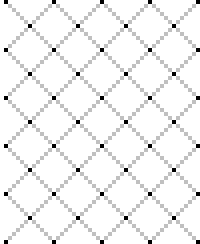
Draw in a line for the passives, between the two vertical lines of pins on the right.
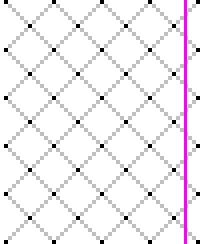
If you are doing a Winkie pin footside, then this is all you need. Start designing the rest of the lace to the left! However, if you are doing a conventional footside, then join the right most vertical line of pins.
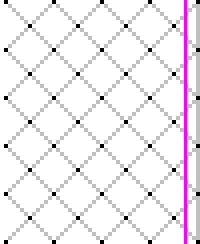
This should work for a Tochon grid. A Bucks Point grid is more squashed vertically, but behaves in a similar way. English MIdland lace may have a problem, though. This tends to be a more sparse lace, with no ground, but instead plaits, with two pairs going between pins, as opposed to a single pair. If you did footside stitchyes where these plaits ended, firstly they might be too spread out, and secondly, you have two pairs coming from the lace rather than one pair, which is rather an embarassment! The solution is to have a single pair bouncing between the lace proper, and the footside. Sometimes it joins the lace with a 2 pair + 1 pair join. Sometimes the single pair just goes round a pin by itself, and immediately returns to the footisde. (For a conventional footside, there will actually be two pairs doing this, swapping over, regularly.)
© Jo Edkins 2026 - return to lace index