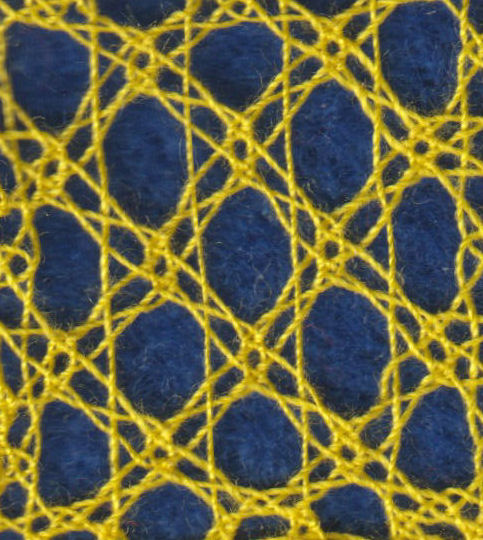
Flemish ground is similar to rose ground but it uses only one pin, in the centre. It might be a good idea to learn rose ground first, to understand the basic principle. Flemish ground is used as a ground or open part of lace in Flemish lace. It can be called five hole ground. See pattern 590.
The traditional representation of Flemish ground in a pattern may not be shown at all, since it is so ubiquitous. But if it is, it will be something like the one on the left. I prefer to mark where the threads go - right.

The older form of Flemish ground had all stitches as cloth stitch and twist. It was worked exactly as standard rose ground but without pins in the normal places. Instead, there was one pin in the centre.
Modern Flemish ground has the cross-over stitches as half stitch. The top and bottom central stitches are cloth stitch and twist, and the side central stitches are half stitch.
The diagram below shows one unit of Flemish ground. It shows each pair of threads as a line. There are two types of stitches in rose ground, cloth stitch and twist and half stitch. The description explains which stitch is used at each stage. The details of each stitch are not shown below - follow the links if you are not familiar with them.
|
|
This shows the cross-overs both above and below the centre. Like rose ground, there are only one set of cross-overs between units. So if the cross-overs have already been done coming out of the previous unit, do not do them again!
Working:
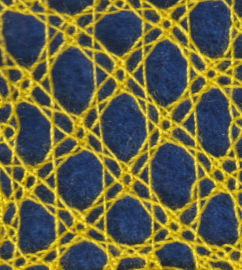 |
Please note that as half stitch is used, the pairs of bobbins get split up. The colour of the pairs above shows their position within the four pairs. It does not refer to specific bobbins. 1. Work left two pairs in half stitch.2. Work right two pairs in half stitch. 3. Work middle two pairs in cloth stitch and twist. 4. Work left two pairs in half stitch. 5. Work right two pairs in half stitch. 6. Put a pin in the middle o0f the unti, between the middle two pairs. 7. Work middle two pairs in cloth stitch and twist. 8. Work left two pairs in half stitch. 9. Work right two pairs in half stitch. |
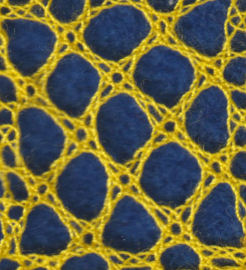 |
The older version of Flemish ground used cloth stitch and twist rather than half stitch. But the pattern of the working is the same. Think of it as standard rose ground without the pins! |
Flemish lace has two pairs entering solid areas at a pin, rather than one as in Torchon ground. The ground is tighter than rose ground, as it is not separated by the pins. The single pin merely centres the unit of ground.
© Jo Edkins 2026 - return to lace index