
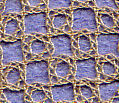
Rose ground is a common ground or open part of lace in Torchon and other lace styles. One unit of rose ground needs 4 pairs on bobbins, 2 on each side. The French for rose ground is cinq trous (five hole), or fond a la vierge (Virgin ground). (But note, five hole ground can also be used for Flemish ground.) The Dutch is Rozengrond. See pattern 10 or pattern 123.
There are other grounds similar to rose ground, such as Flemish ground or filled rose ground or pinned cross-overs rose ground.

Pattern representation of a rose
The tradition pattern of a rose is a group of four pin holes with a small diamond within - see above left for four units of rose ground. I prefer to mark out exactly where the pairs go, especially at the corners (where mistakes often happen) - see above right.
The diagram below shows one unit of rose ground. It shows each thread as a line, with the different pairs different colours. There are two types of stitches in rose ground, cloth stitch and twist and half stitch. The details of each stitch are not shown in detail below - follow the links in the previous sentence if you are not familiar with them.
|
|
Working: Work the left two pairs in cloth stitch and twist. Work the right two pairs, also in cloth stitch and twist. These two stitches have no pins. I call them "cross-overs".
Now work the middle two pairs with half stitch, pin, half stitch (this is a Torchon ground stitch). Work the (new) left two pairs in half stitch, pin, half stitch, then the right two pairs, and finally the middle two pairs. These four stitches do all have pins. Finally work the left two pairs in cloth stitch and twist (no pin), then the right two pairs the same.
Rose ground is essentially a diamond of four Torchon ground stitches, surrounded by the corner cross-overs, caused by the cloth stitch and twist. Please note, the cross-overs happen at the start of rose ground, between units of rose ground, and at the end. If you followed the description above too rigidly for multiple units of rose ground, you would get two lots of cross-overs between the units, and this would be wrong. When working rose ground, you need to say for each unit "Have the left two pairs got a cross-over from a previous unit? Have the right two pairs?" If not, do them. If they have, then leave out the cross-overs, and go straight onto the Torchon ground stitches. The commonest error in rose ground is to leave out the cross-overs. Doing them twice is less common, because the stitch obviously looks wrong as you are working it. But it is all too easy to leave one out, and not notice it until the lace has been finished. Been there, done that....
Rose ground is a ground, and can be used to fill in spaces between other shapes in the lace. However, since you need four pairs, and four pins, in a rigid pattern, for one unit of rose ground, you sometimes have a little space round the edge where there is not room for a complete rose ground unit, but there is still a pin hole or two. You can fill this space either by doing a Torchon ground stitch for every spare pin, or by doing as much of a rose ground unit as you can. If you look at the rose ground edge, you can see an example of this which makes an attractive edge.
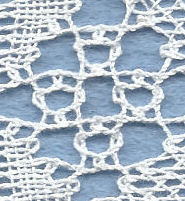
The working above used cloth stitch and twist for the cross-overs, and Torchon ground for the centre. There are many different types of rose ground, with different stitches, while using the same principle. This photo shows cloth stitch and twist for the cross-overs, and double Torchon ground for the centre. Perhaps we could call this double rose ground! See pattern 324 for a sampler comparing two different rose grounds.
The photo also shows a common feature of rose ground or any type. It can be used to fill in space near the footside, like most ground. But it can also be used as a regular group of units, surrounded by solid shapes. The photo shows four units, which makes an attractive cross. You could have 9 or 16 units, which would make a diamond. If you do this, you do not have the problem of filling in the spare area round the edge!
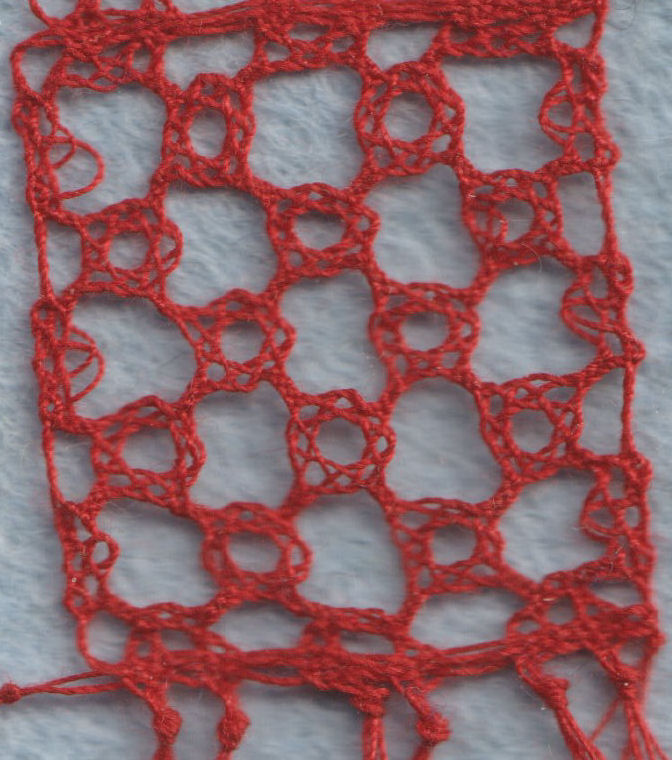
Here is another type of rose ground which was discovered by accident! The crossovers are not just cloth stitch and twist. Instead they are two cloth stich and twist on top of each other (four half stitches). This makes the cross overs into little plaits. It has the effect of making the central rose more rounded, which I think it rather attractive! I shall call it plaited rose ground. It happened because someone was doing rose ground, and did the crossovers above and below the central rose for all roses. That meant that the crossovers in the middle had two lots of cloth stitch and twist, producing little plaits.
You could use this as an effect in Torchon ground. See pattern 512.
In pattern 588, I tried variouys combinations of different stitches.
Cross-overs: half stitch (CT), cloth stitch and twist (CTCT), double cloth stitch and twist (CTCTCTCT)
Central: half stitch pin (CT pin), half stitch pin half stitch (CT pin CT), cloth stitch and twist pin cloth stitch and twist (CTCT pin CTCT)
This included the 3 rose ground types above (standard, double, plaited). Some just didn't work! But here are some more:
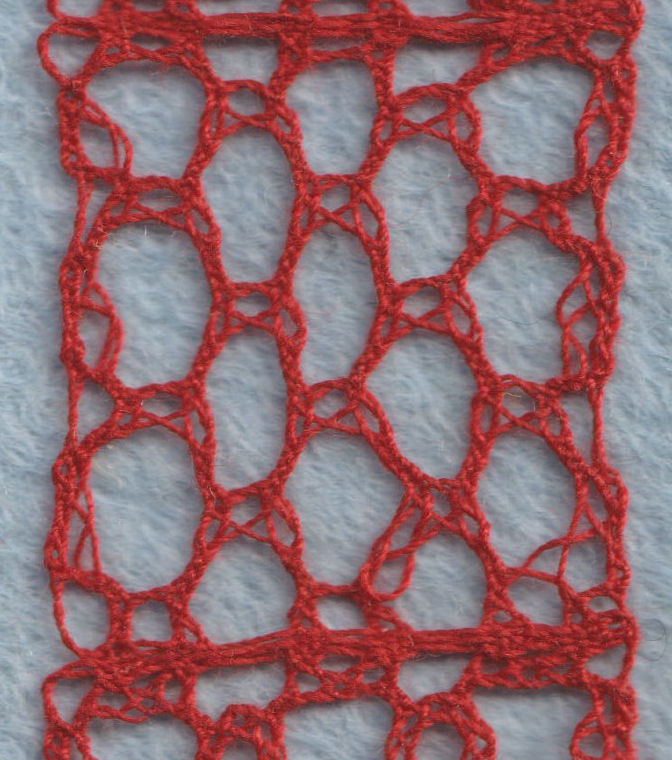
Half stitches everywhere: Cross-over - half stitch (CT). Centre half stitch pin (CT pin). Flowing lines. But be careful how it fits into edges etc. Maybe a Torchon ground stitch or so as filler.
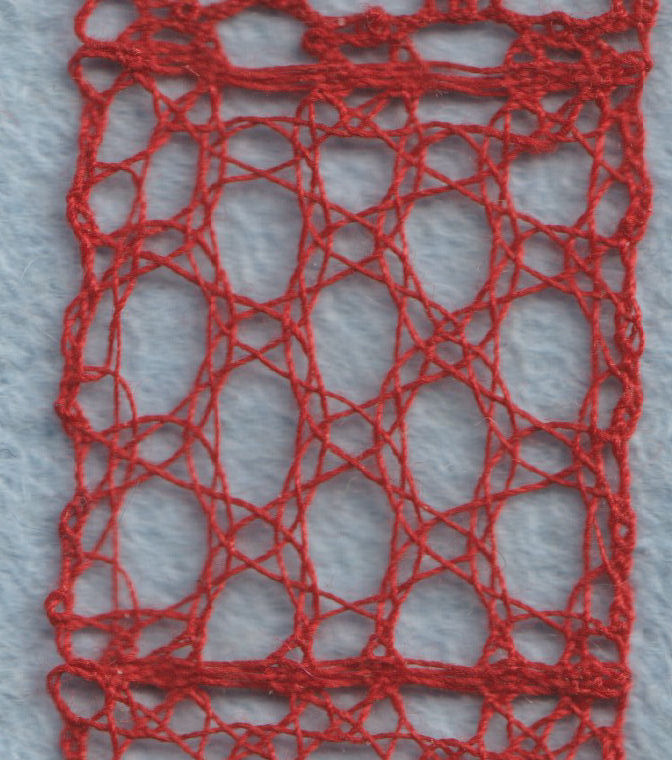
Standard centre, but half stitch cross-overs - Cross-over - half stitch (CT). Centre half stitch pin half stitch (CT pin CT). Definitely a different effect to standard rose ground.
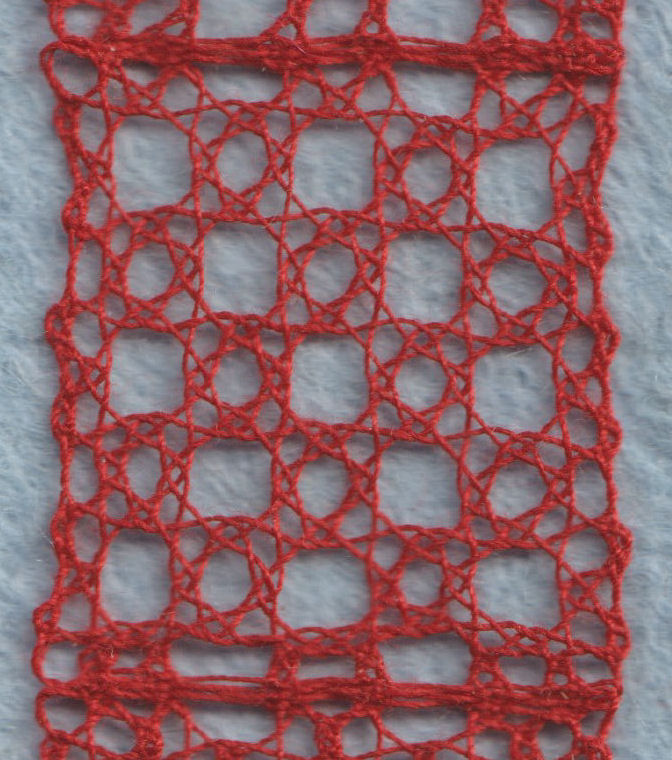
Double centre, but half stitch cross-overs - Cross-over - half stitch (CT). Centre cloth stitch and twist pin cloth stitch and twist (CTCT pin CTCT). A different effect to double rose ground.
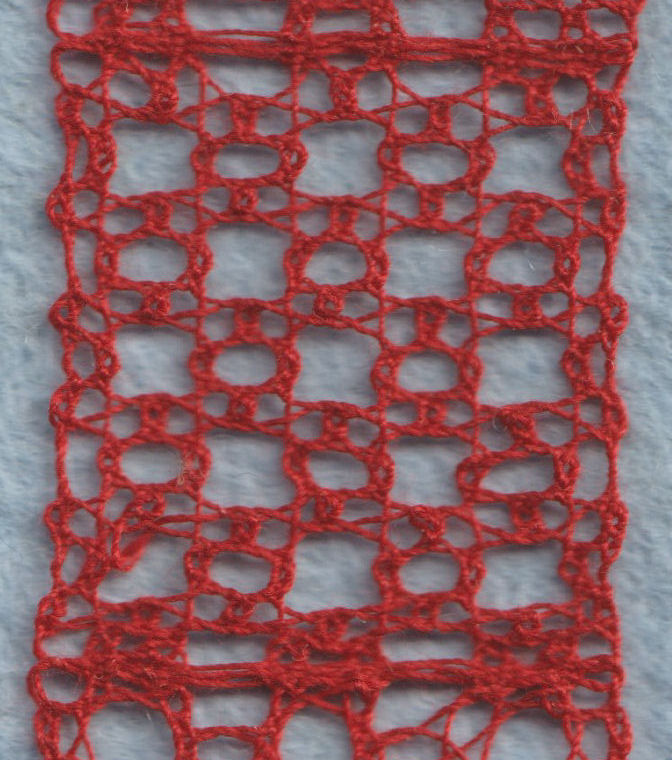
Cross-over - double cloth stitch and twist (small plait). Centre half stitch pin (CT pin). Just because it's so weird!
© Jo Edkins 2026 - return to lace index


