

This pattern uses rose ground as a proper ground, (rather than a cross as in the Torchon sampler). It introduces scallop headsides. The footside has no passives.
Pattern:
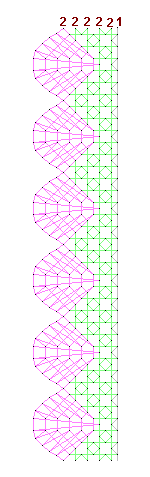
Bobbins: 11 pairs
Style: Torchon
Stitches:
half stitch
cloth stitch and twist
Details:
scallop headside (pink)
rose ground (green)
Torchon ground (grey)
footside without passives (grey)
Description:
While previous patterns have had footsides and rose ground, this pattern has a slightly different twist on both.
The footside has no passives. This makes it easier than a conventional footside, but click here if you want more explanation.
There is more rose ground than the Torchon sampler, so be careful to sort out which four pairs are needed for each unit of ground. Also make sure that you don't forget any cross-overs! The pattern marks them, so before every unit, check that you have cross-overs from a previous unit (or do them now), and remember to do the cross-overs after each unit. This rose ground has an extra problem in that it needs to fit next to the footside, which goes straight downwards rather than diagonally. However, if you work the rose ground units as shown, and the footside as shown, you will find that there is only one pin next to the footside which is not covered by either. Work that pin as Torchon ground. (Generally, it is a good rule, if you have a pin without any particular stitch connected with it in Torchon, work it as a Torchon ground stitch.)
Click here to see how to work a scallop headside, which includes an animation, that you can repeat, or step through. Scallops need quite careful tightening, as they use cloth stitch and twist, which is harder to tighten than other stitches, because of two twists per pair, per stitch. There is more than one way to work a scallop - the explanation goes into more detail. It doesn't matter which you use, here.
© Jo Edkins 2016 - return to lace index