| U3AC walks | U3AC walk - Art in the city centre |
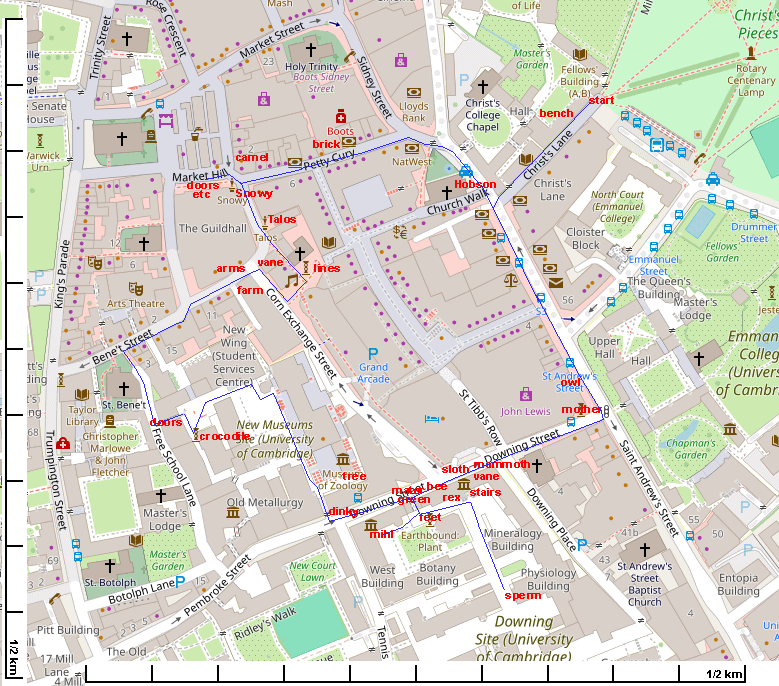
Route: Bus station, Christs Lane, St Andrews St, Downing St, Downing site, New Museum site, Free School Lane, Benet St, Kings Parade, Market, Guildhall St, Lion Yard, bus station.
Length: 1 mile Start and finish: bus station
Introduction: Looking at art in the city centre (for quite a large definition of art!) When I was designing this walk, I found far too much! So I am splitting it into two, art we will look at on the walk, and art we probably won't, but you might like to look at for yourself, later.
We start at the Christs Pieces end of Christs Lane.

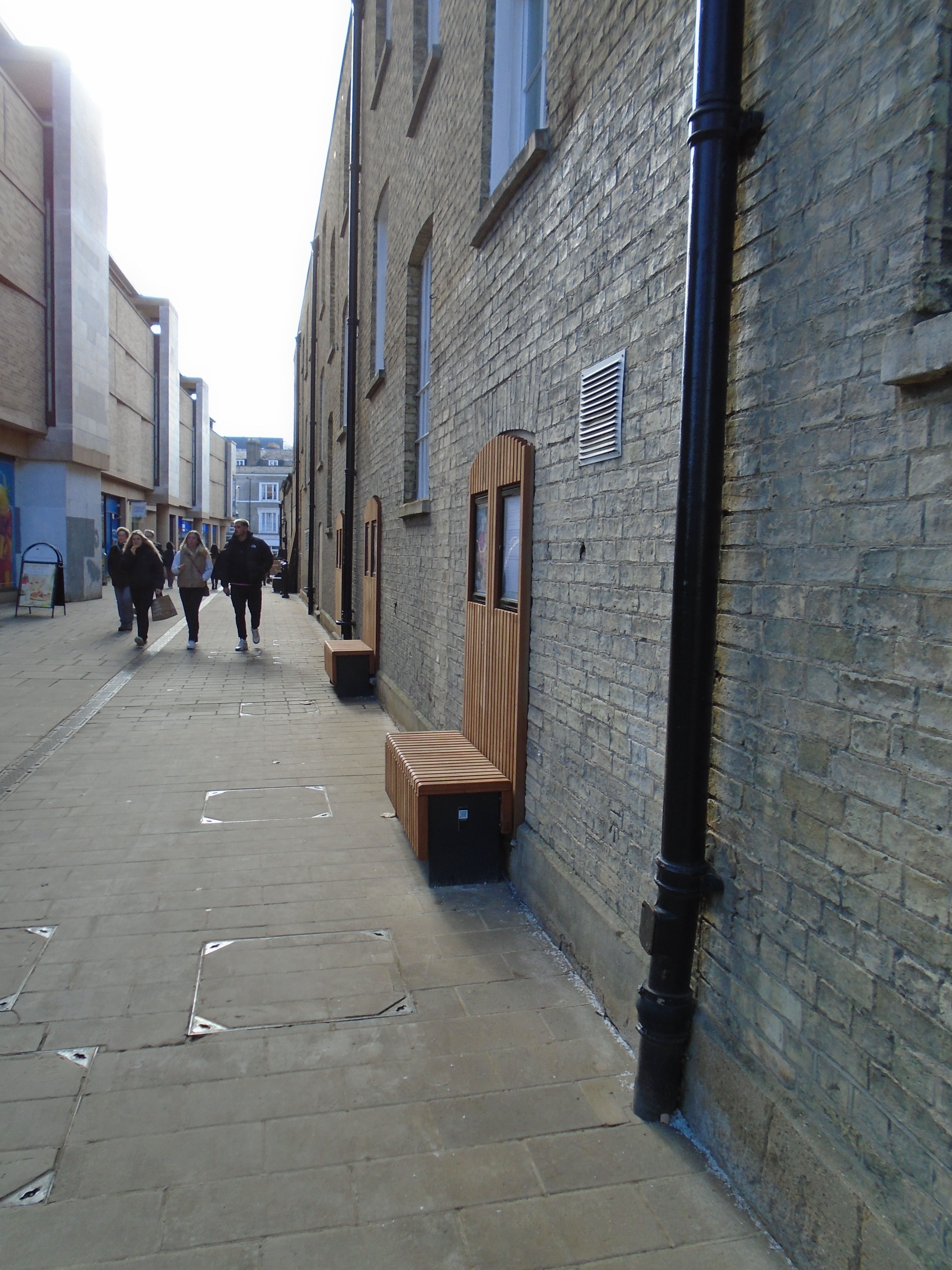
Christs Lane is an old road, but was closed off for some time. It has been reopened, but is still a little grim. To cheer it up, the council installed these Art benches appeared in 2023. They have temporary displays of art. Also people sit on them, and why shouldn't they, but it does mean you can't see the art very well! More information in the photo below.

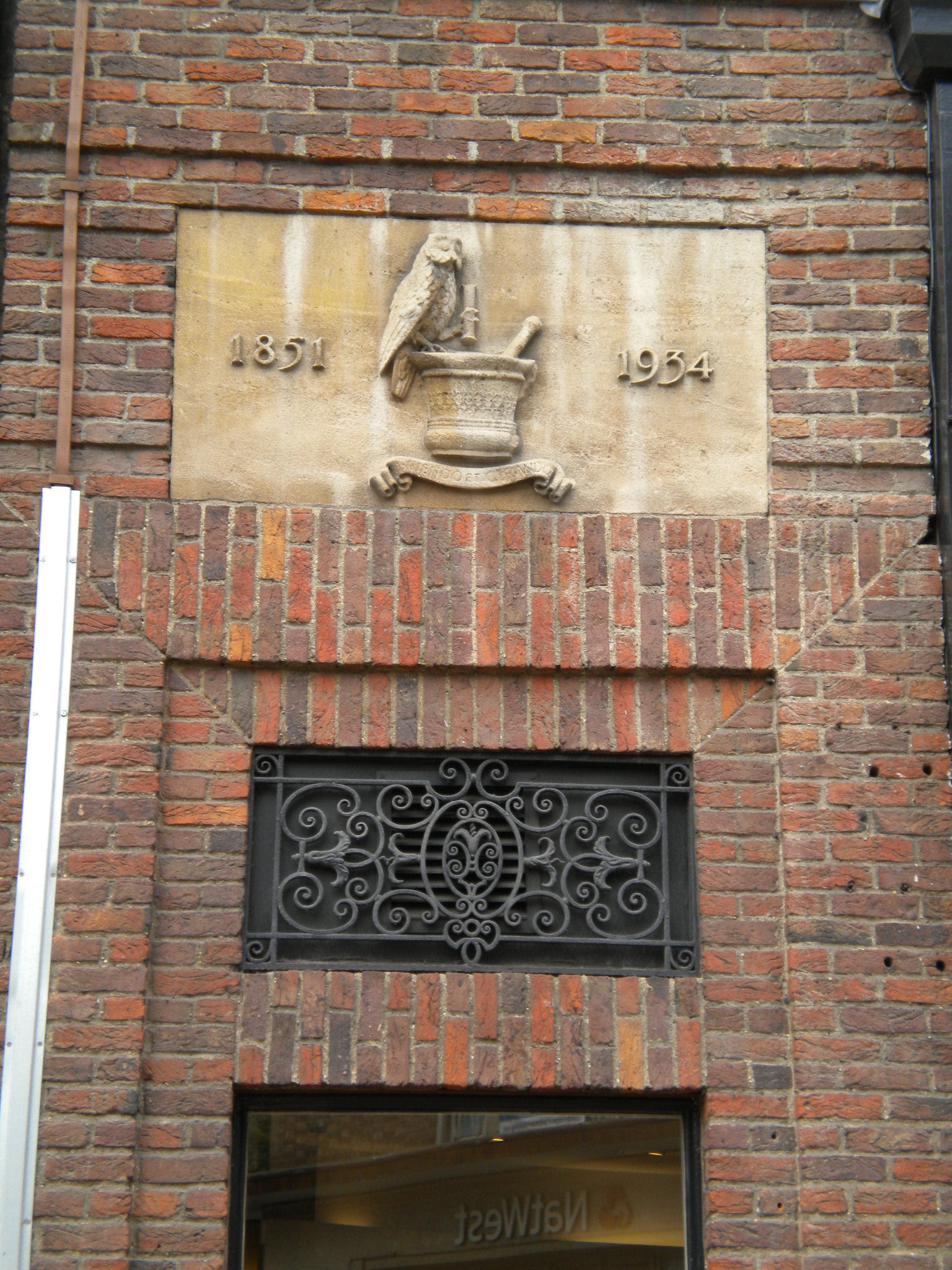
Above 19-20 At Andrews Street, there is an owl, sitting on a pestle and mortar. This shows that this shop was originally an apocathary. These sold medicines, like a chemist, but they ground up the ingredients themselves. The owl is a symbol of wisdom.
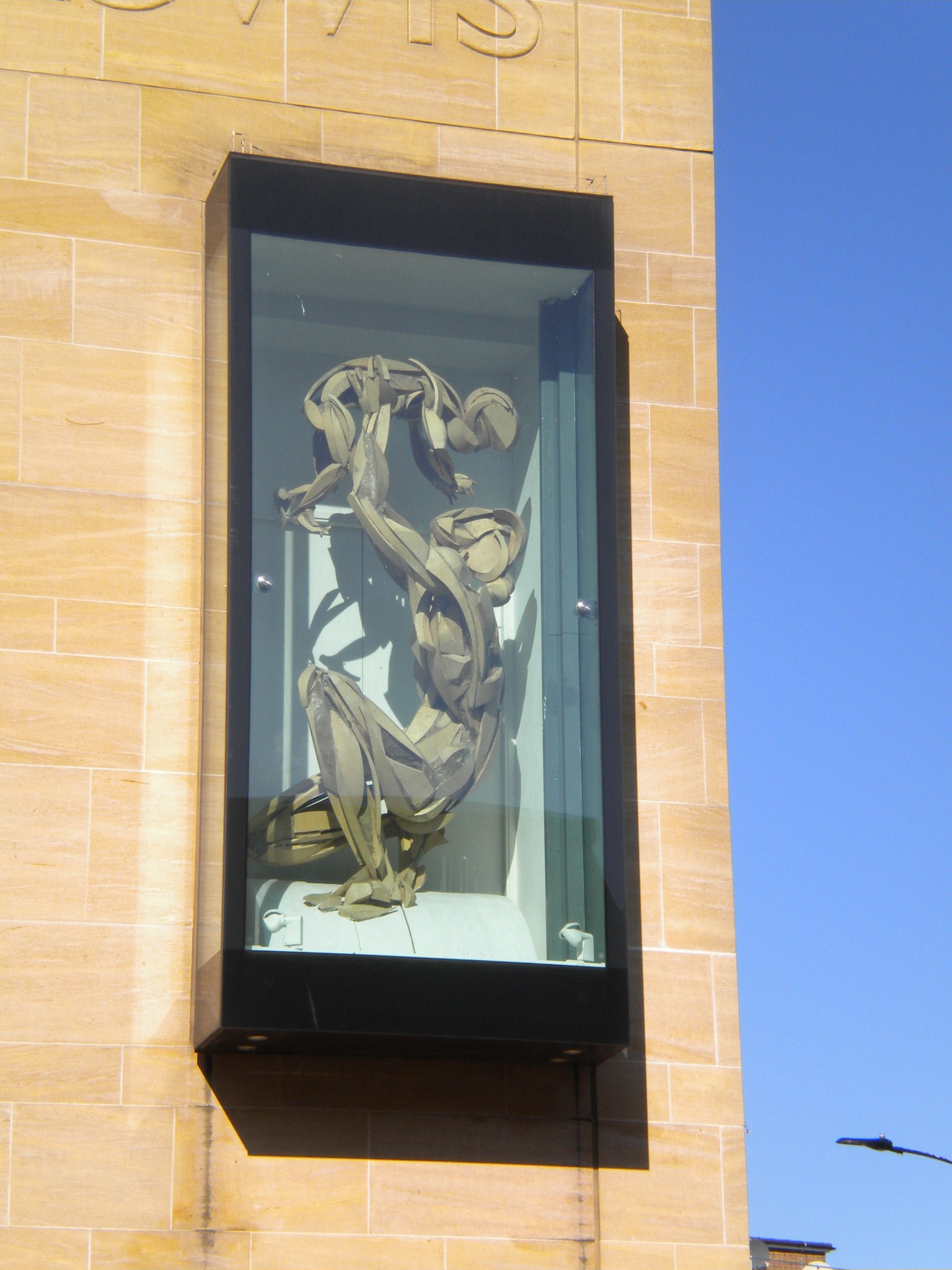
Turn left into St Andrews St, and walk down to the junction with Downing Street. Cross the road, and turn into Downing Street (with care! It's a busy junction.) Look up to see this sculpture on the side of the John Lewis building. It faces Downing Street, and is quite high up the building. It is called Mother and Child, by Sophie Dickens, and is dated 2008. It is made of carved wood.
Walk along Downing Street. The Downing Site is on the left (not part of Downing college, by the way) The Downing Site has various science faculties and departments. Perhaps surprisingly, it also has some art. On the wall (which is the back wall of the Sedgwick Museum), you can see this rather fine mammoth.

Beyond, there are the coat of arms of Cambridge University, supported by an iguanodon (on the left) and a giant sloth (on the right). All these animals are part of the Sedgwick Museum collection.

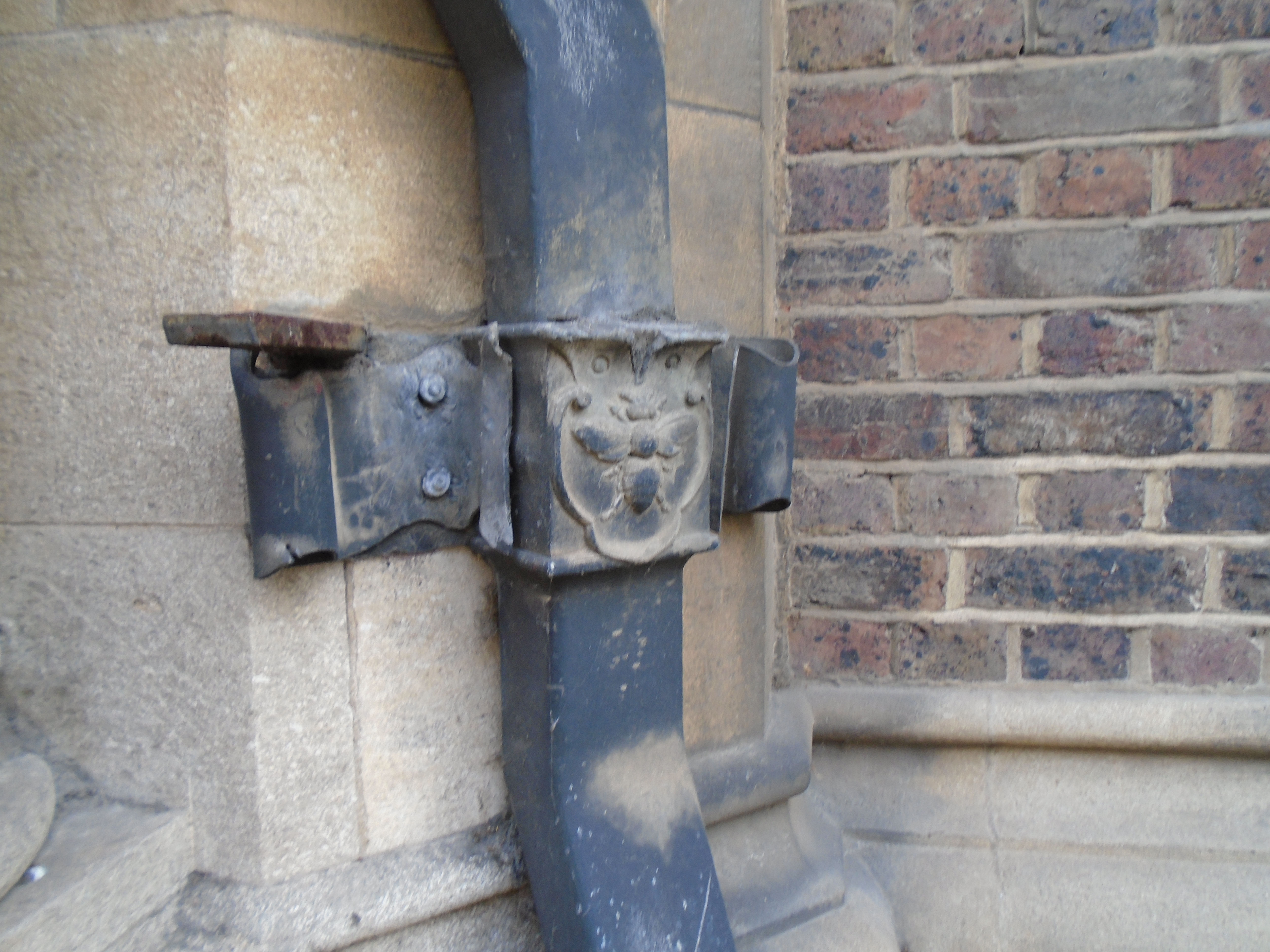
The drainpipes on the front of the Downing site are decorated with bees.

This is above the gate to the Downing Site. The motton says "Hinc lucem et pucula sacra" which means "Out of here comes light and sacred draughts". The lady in the middle holds a sun and a cup to represent these. She is labelled "Alma Mater Cantabrigia", which means "Bountiful mother Cambridge". If you look carefully at her, she is indeed bountiful - she's lactating! She's the University's emblem.

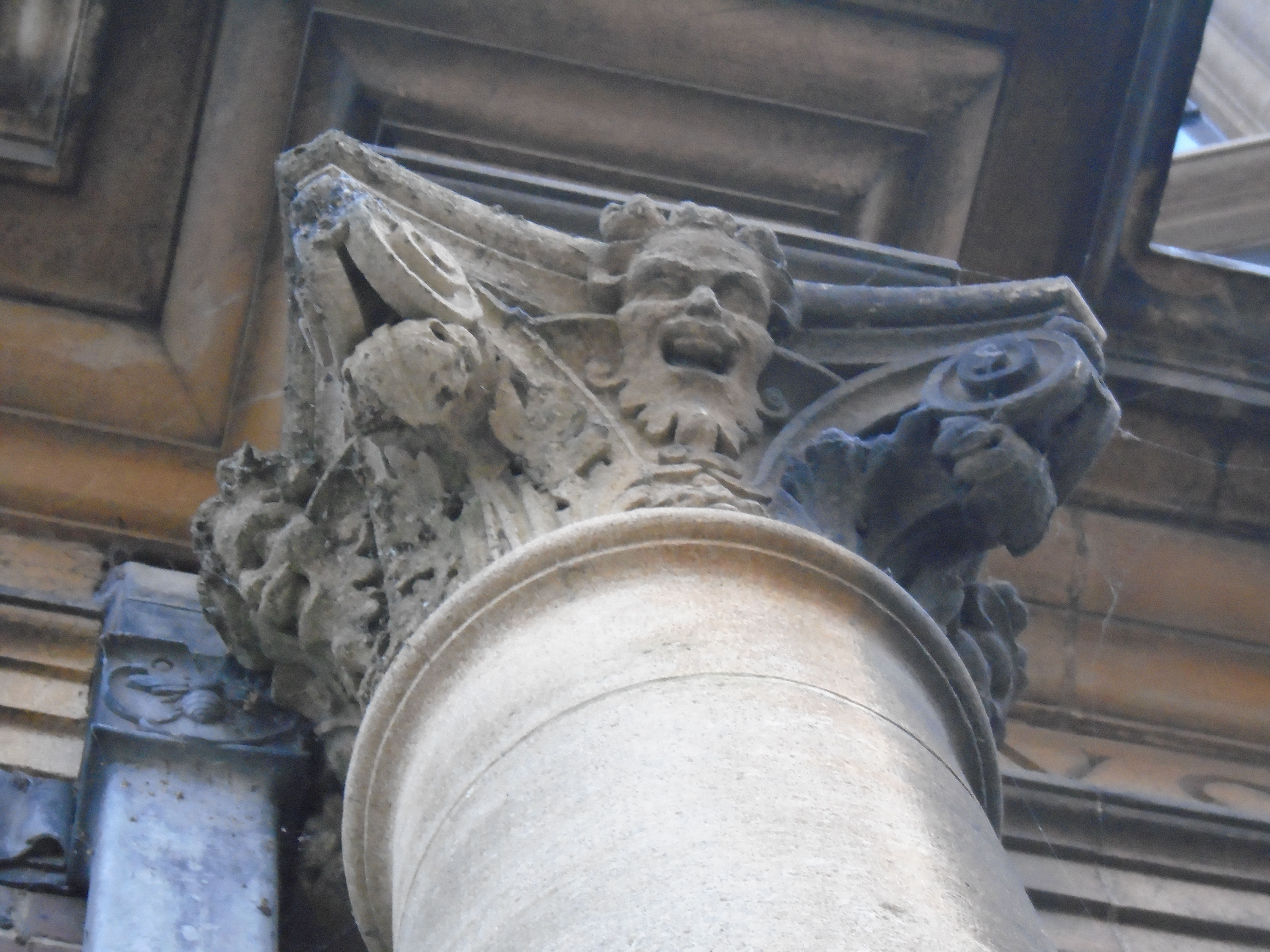
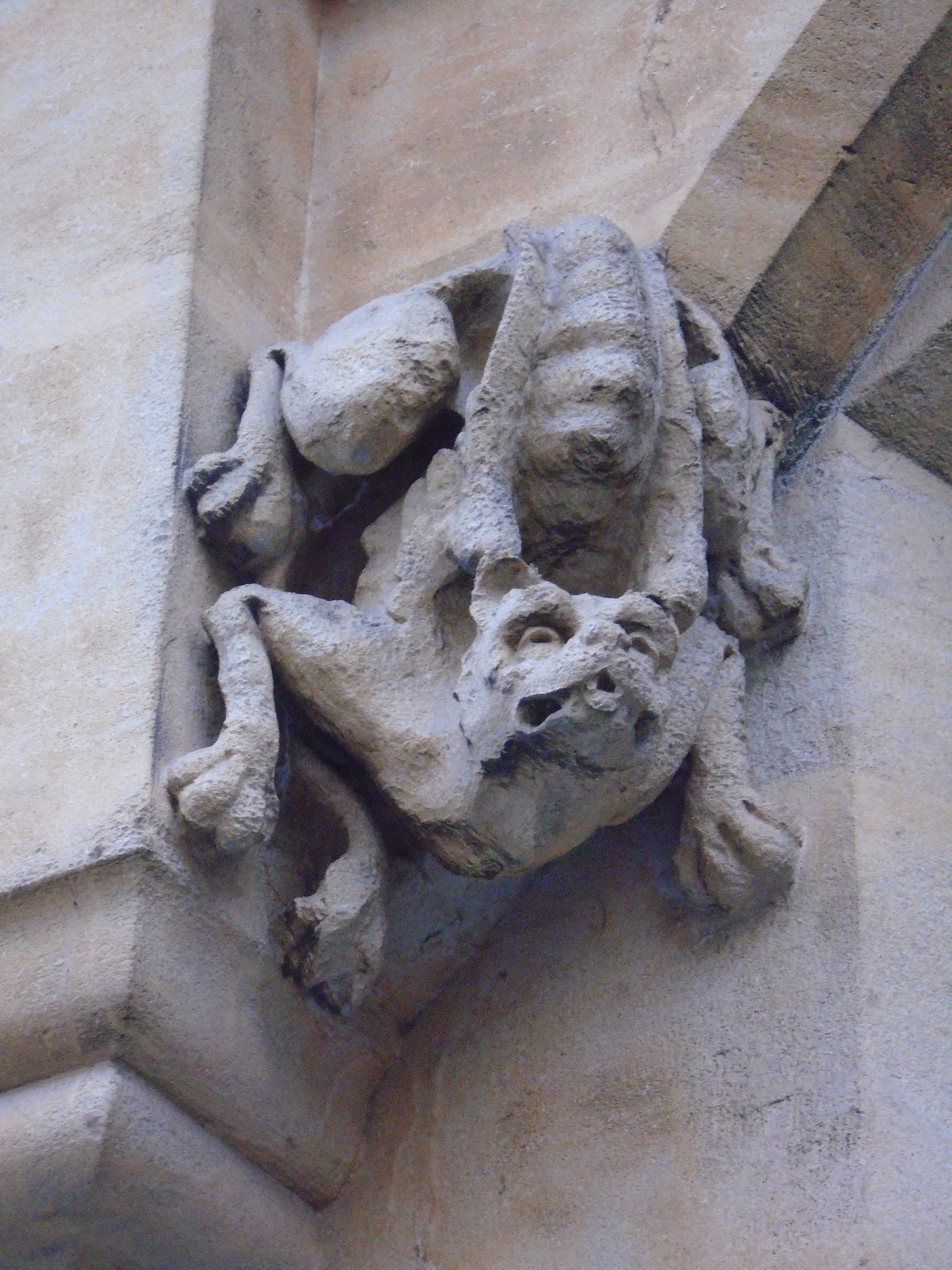
Turn left into the Downing Site, under these gren men (and a lion). These are monsters (myths?) which can be found in medieval churches, although here they are Victorian. The pillars have grining faces as well.


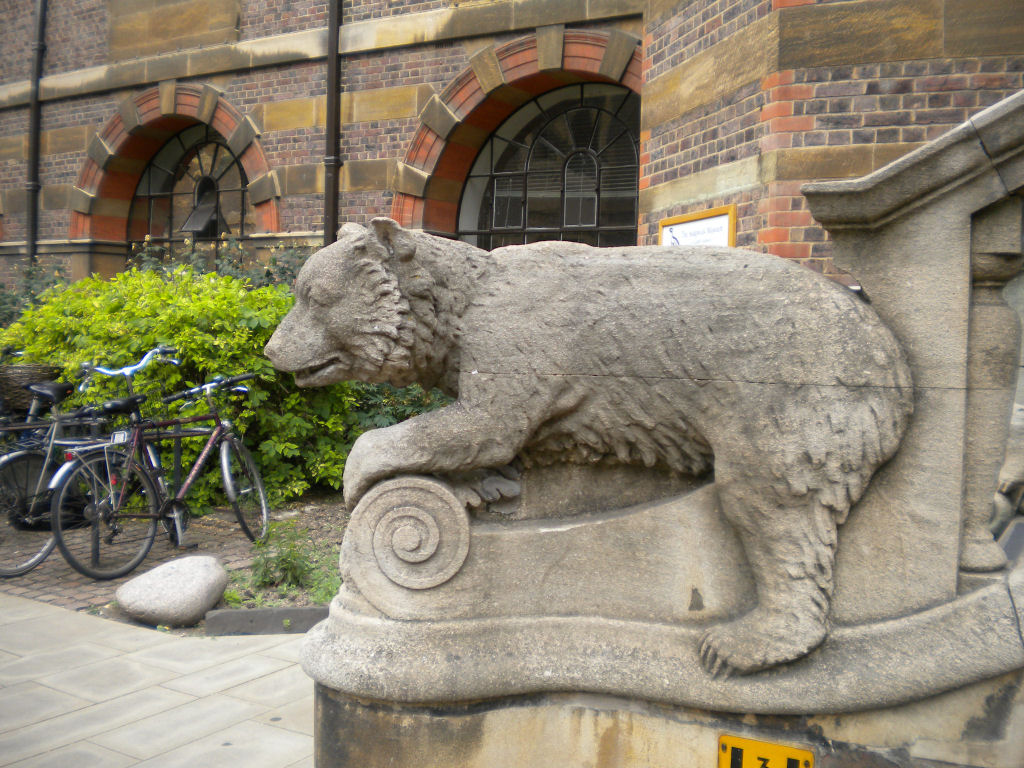
The architect of the Sedgwick Museum was Thomas Graham Jackson and he was responsible for this art. (See this website.) The museum was opened in 1904. The stairs leading to the museum have pairs of splendid animals at the bottom, bears and bisons. Why bears and bison? In 1904 geologists found fossils of bear and bison in the gravels of Barrington, a village south-east of Cambridge.

There is also a model of a dinosaur, Clare the Tyrannosaurus rex by Ian Curran. It was centrepiece at Clare college's "Primordial" May Ball in 2014, and then acquired by the Sedgewick Museum, which involved moving it through the centre of Cambridge! See more here.

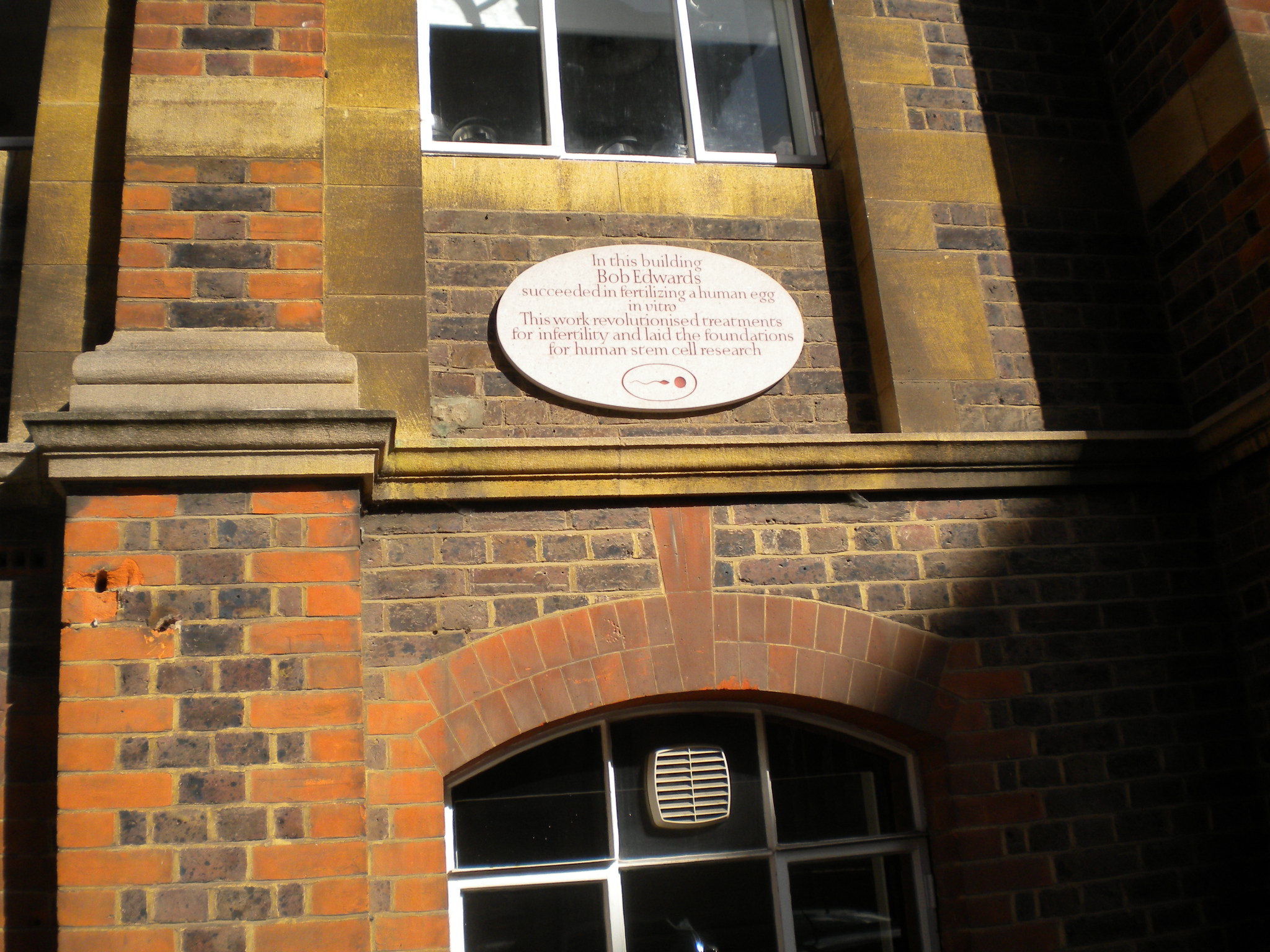
This plaque is inside the Downing site, which houses various scientific departments and facilties. This are on the outside of the Physiology Building. Not perhaps a wonderful work of work, but how many artworks (or buildings) have a sperm on them!
Antony Gormley is one of Britain's best known contemporary sculptors. He made the Angel of the North. There is a Gormley sculpture in Cambridge which is rather smaller! In fact, it takes some finding. Near the entrance of the Downing Site, in the paving, you will see two human-sized foot prints. Apparently this installation is a human figure buried up side down with only the soles of the feet showing. There is no information near-by about it, and you can walk right over it without seeing it if you're not careful. It is dated 2002, and it is called Earthbound: Plant.

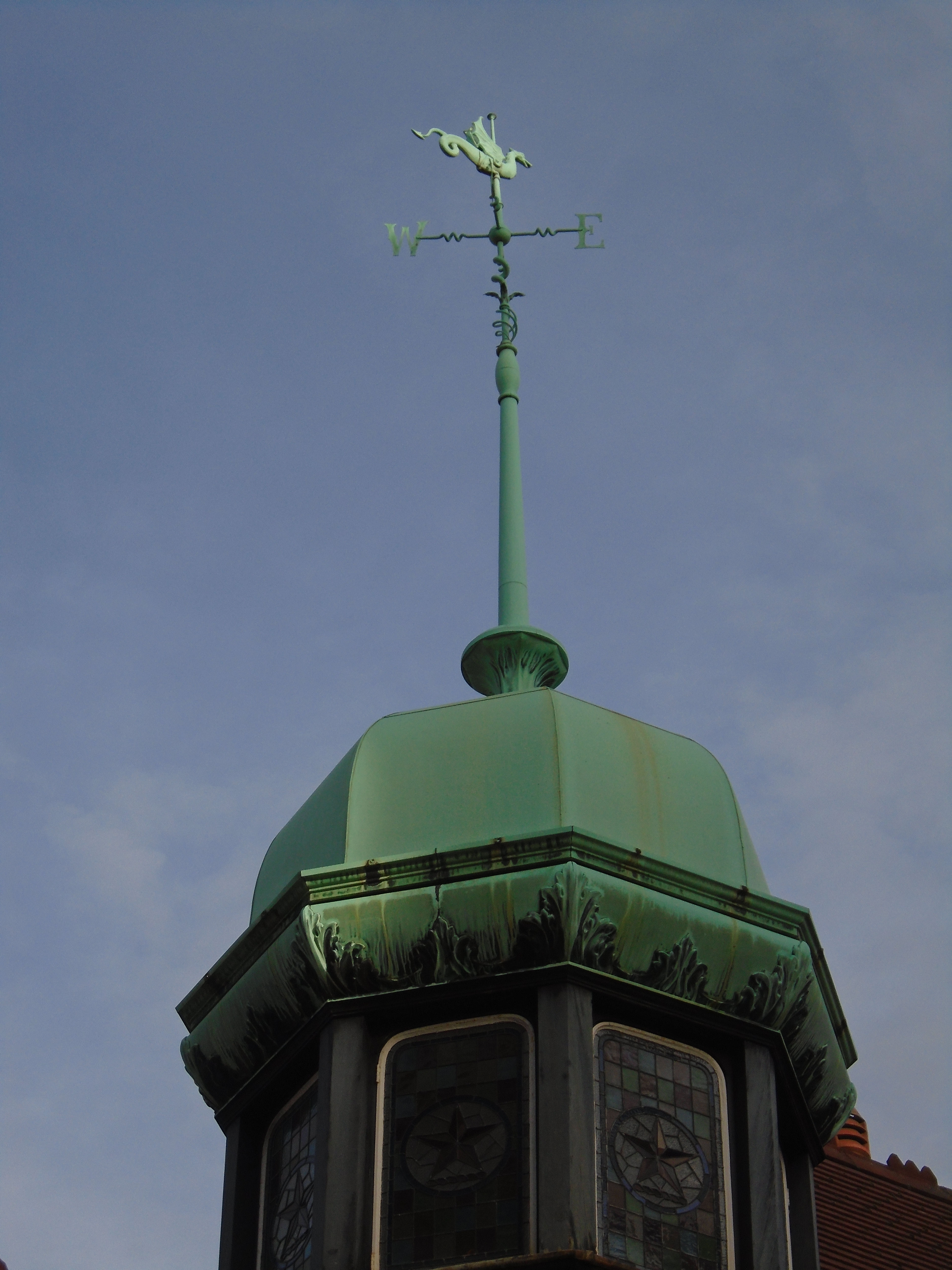
Above the Sedgwick Museum, there is a weather vane with an ichthyosaur on it!

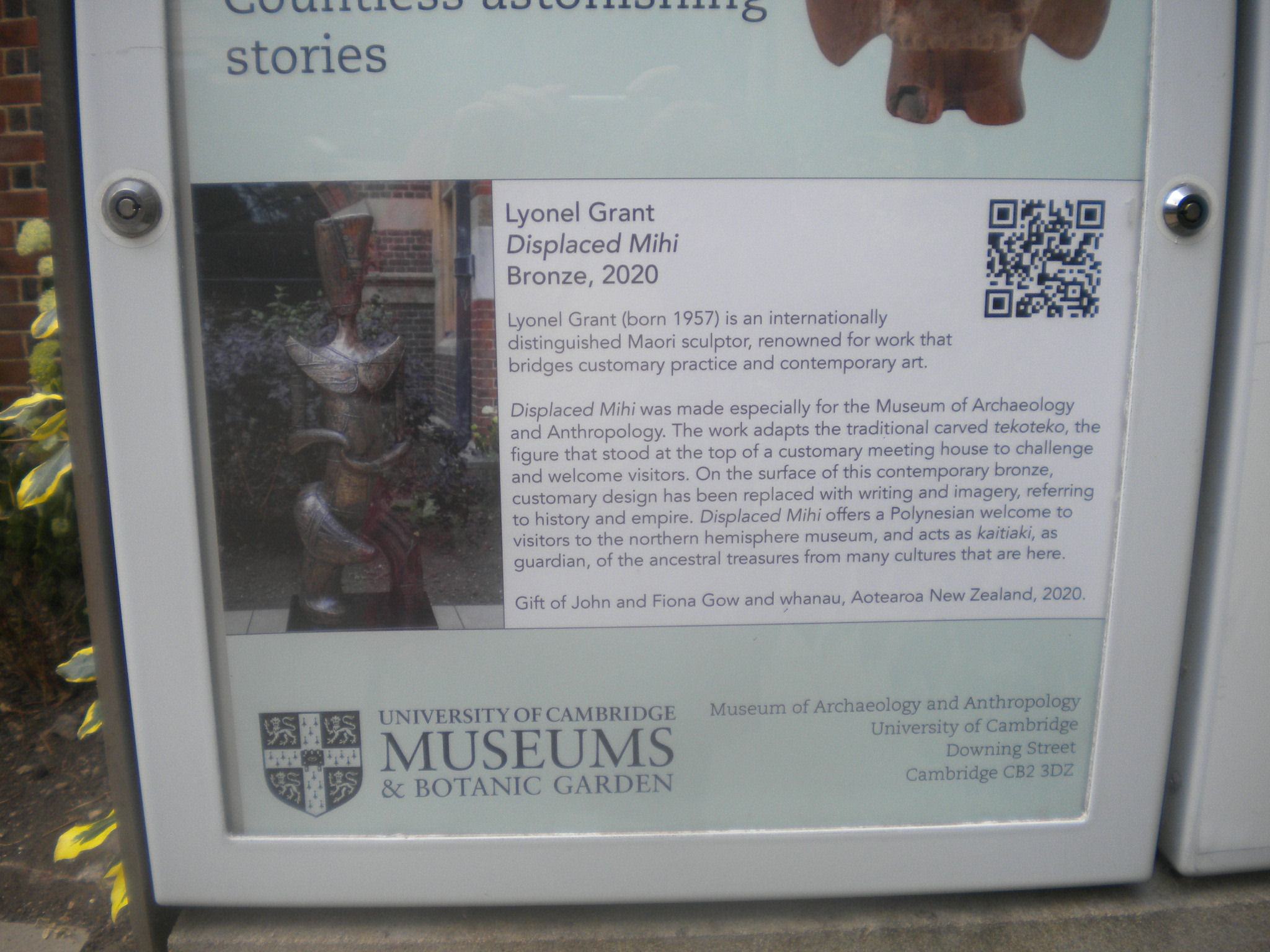
Continue on to another corner of this court to see this sculpture, by the back door to the Arc and Anth museum, which is in the corner. There is a board nearby, which says:
Lyonel Grant (born 1957) is an internationally distinguished Maori sculptor, renowned for work that bridges customary practice and contemporary art.
Displaced Mihi was made especially for the Museum of Archaeology and Anthroplogy. The work adapts the traditional tekoteko, the figure that stood at the top of a customary meeting house to challenge and welcome visitors. On the surface of this contemporary bronze, customary design has been replaced with writings and imagery, referring to history and empire. Displaced Miki offers a Polynesian welcome to visitors to the northern hemisphere museum, an acts as kaitiaki, as guardian, of the ancestral treasures from many cultures that are here.
Gift of John and Fiona Gow and whanau, Aotearoa new Zealand, 2020.


Leave the Downing site, and turn left, crossing the road. Look down to see a Dinky Door. These miniature doors started appearing in 2019. They are made by a pair of anonymous artists to cheer us all up! This one is, of course, 10 Downing Street. The octopus is not explained however.

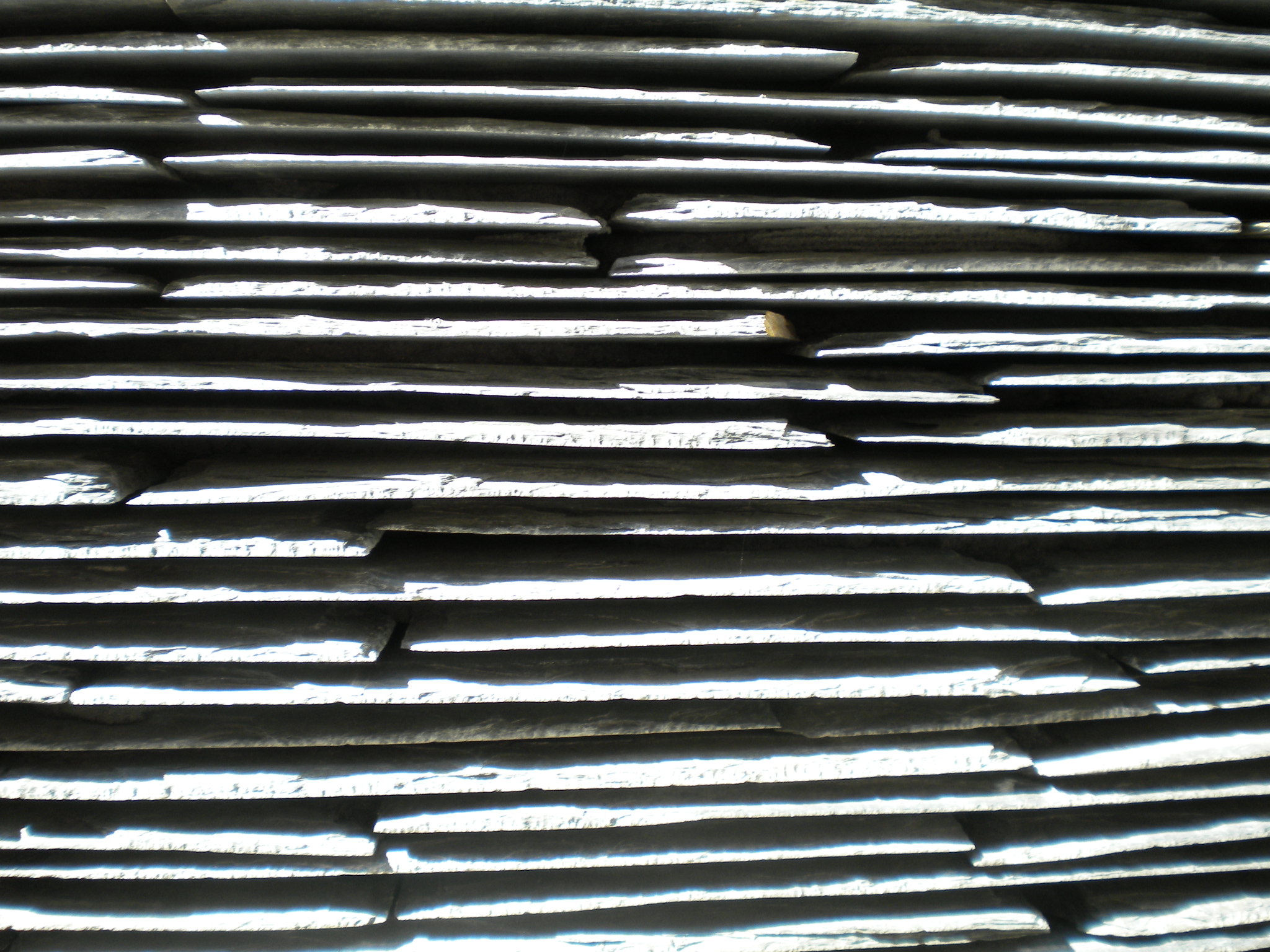
Turn right into the New Museum site. There is a striking art work made of slate on the end of the Zoology Museum (on your right), called Slate Work South. It represents a tree and is made of Welsh slate. Holes have been left between them in the hope that native bees will use them! The artists are Heather Ackroyd and Dan Harvey and these were commissioned in 2016. Their website is here - it describes the work in more detail.

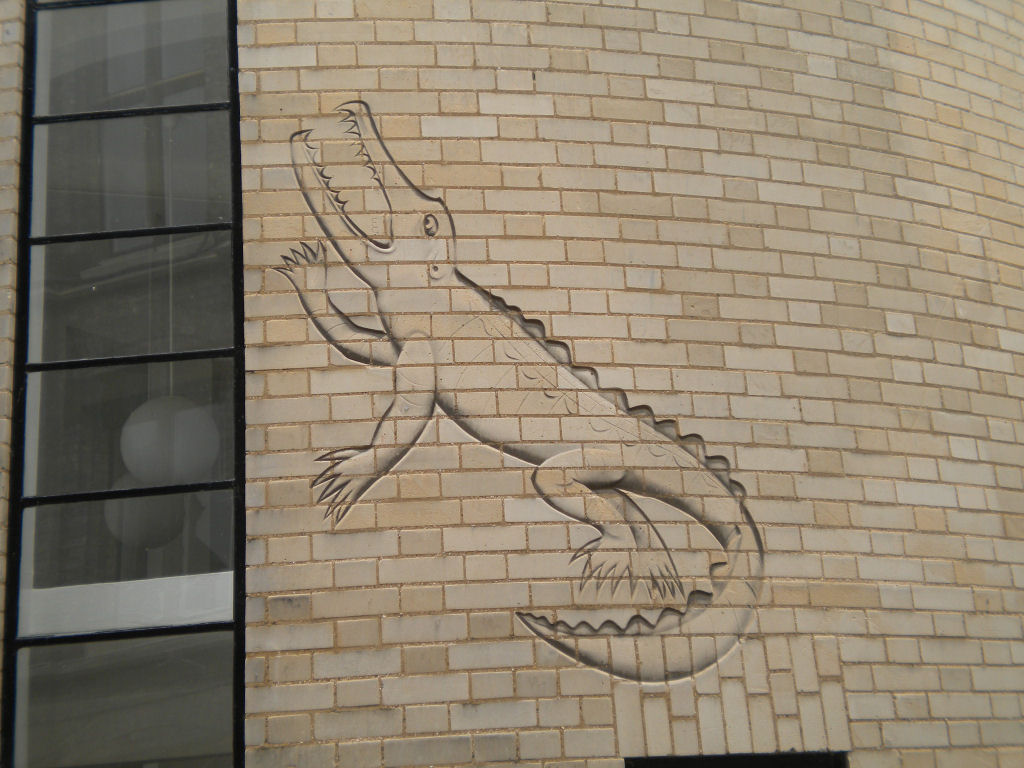
Carry on walking straight forward, then at the end, turn left. You will eventually see another gate in front of you which leads out to Free School Lane, but before going through it, turn to your left to see a crocodile carved into the brick wall. This is the outer wall of the Mond Laboratory. The Laboratory was built in 1933 by the Royal Society for Kapitza to continue his work into intense magnetic fields. During the building work, those passing the lab were surprised to see a figure in a brown monk's habit busily chipping away at the brickwork behind a tarpaulin screen. This was Eric Gill who had been commissioned by Kapitza to carve both a plaque of Rutherford and this Crocodile - "The Crocodile" being Kapitza's pet name for Rutherford, either because of his fear of having his head bitten off by him, or because his voice could be relied upon to precede his visits, just like the crocodile's alarm clock in "Peter Pan".
The door of the Old Cavendish has this, from Psalm 111, "Magna opera domini exquisita in omnes voluntates eius" which can be translated as "Great are the works of the Lord. They are sought out by all who delight in them." This is a good tag for scientists!


Walk through the gateway into Free School Lane and turn right. At the end, turn right into Benet St. At the back of the Guildhall, above the old library, there is the Cambridge City coat of arms.

The other side of the road, there is an ornate house with a weather vane on top. That has a seahorse! The building dates from 1898.

The Corn Exchange is also on your right. It has these carvings about farming, including a plough team. The Corn Exchange was built in 1875.


Walk down Corn Exchange street a little, then left into Fisher Square.
Tucked between the Guildhall and Lion Yard shopping centre, there is a small square called Fisher Square, used by shoppers to sit out in the sun, although most wouldn't know the name. In the middle is this sculpture called Between the Lines. Installed in 2007, it is made of granite, and is by Peter Randall-Page.

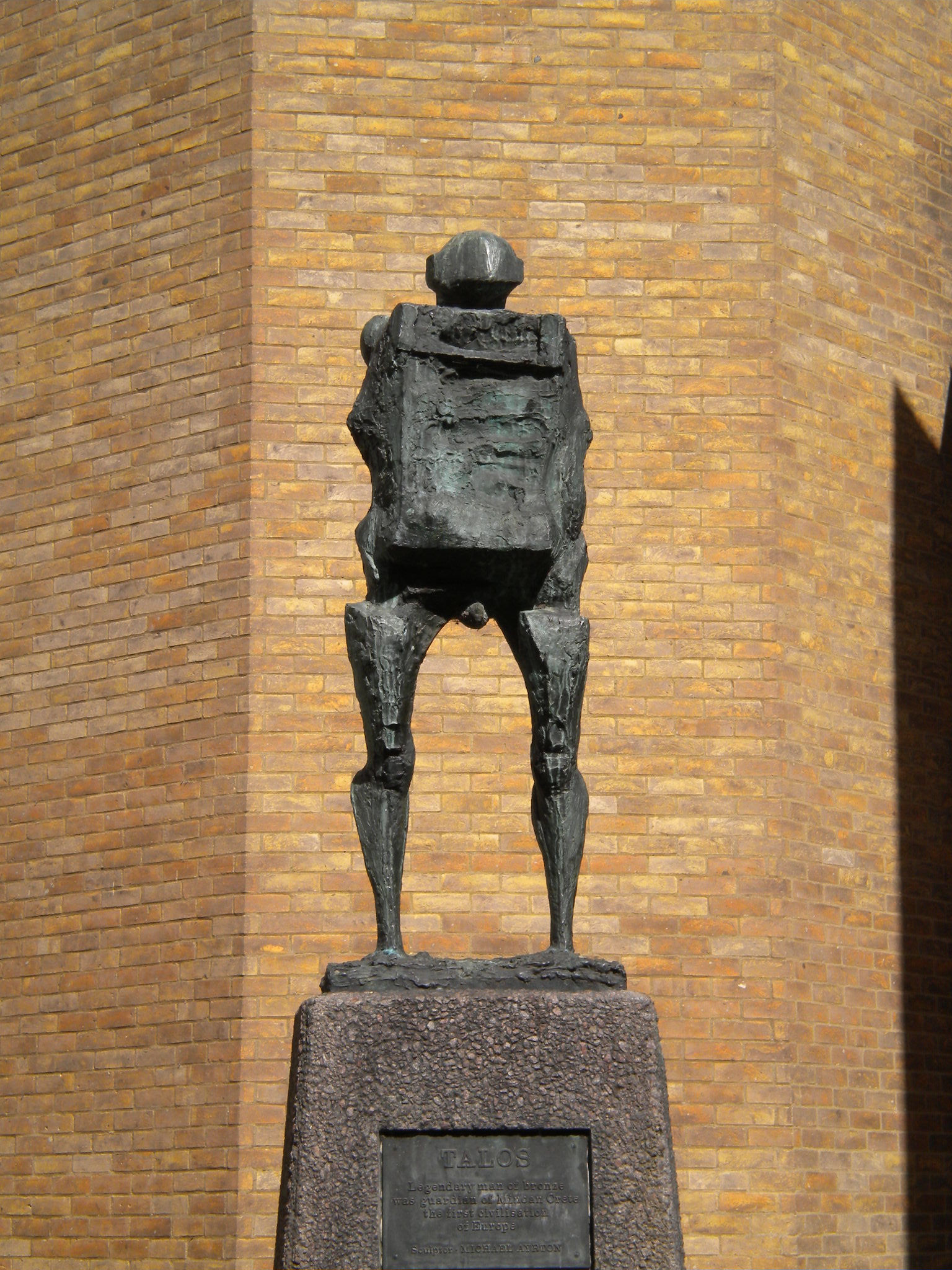
Walk back towards the market place, passing the bronze statue called Talos. The date given for it is 1950, but it was put in its current position in 1973. It has a plaque which says "Talos: Legendary man of bronze was guardian of Minoan Crete, the first civilisation of Europe. Sculptor, Michael Ayrton"
On the corner of the Guildhall is a memorial to Snowy Farr. He was was a greatly loved character of Cambridge, who collected money for the Guide Dogs for the Blind Association. He wore a red uniform and top hat, and had a magnificent white beard. He had a small cart, with animals, and his cat used to sit on top of his hat, while mice ran round the rim. When he died in 2007, it was decided to have an artwork commemorating him. Here it is. It is called Snowy, by Gary Webb, and was unveiled in 2012. The second photot shows Snowy in all his splendour.


Walk to the front of the Guildhall, which is 1930s. Above the doors is the Cambridge City coat of arms.

The doors of the Guildhall were made by Lawrence Bradshaw, in 1933.


There are also two decorated pedestals either side of the door, often used by tourists to sit on.


Opposite Snowy, there is a coat of arms on the house on the corner of Petty Cury, facing the market, with a camel on top, and 9 cloves on it. It is the coat of arms of the Worshipful Company of Grocers, and this used to be a grocer. It's fun to ask people where there is a camel in the market place!

Walk down Petty Cury. This carving is on the wall of a shop in Petty Cury. I know nothing about it!

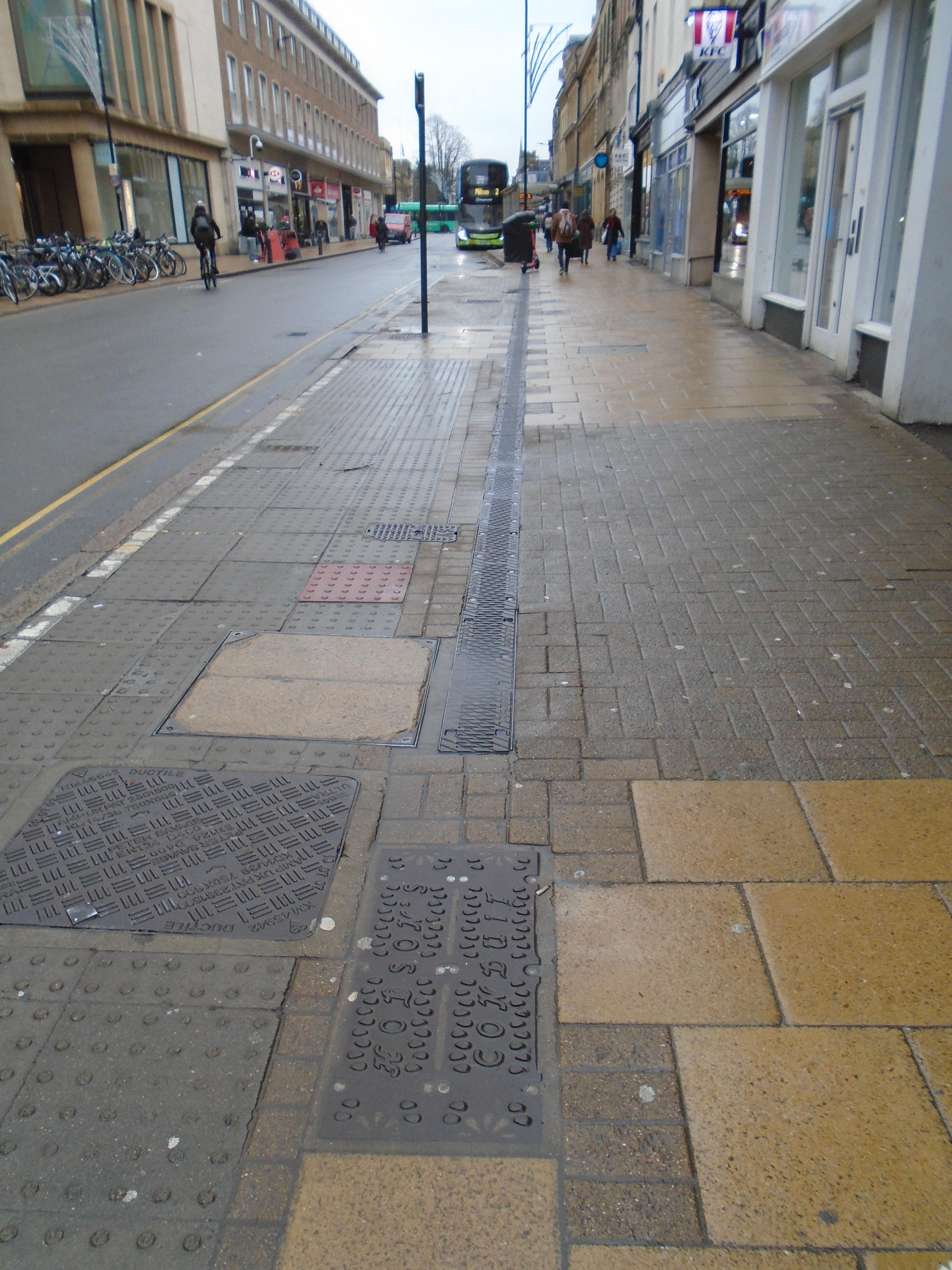
By St Andrews the Great, on the pavement there is one of several modern markers of Hobsons Conduit. The open channels in Trmupington Street, in fron of the Fitzwilliam museum, are well known, but this is another channel of Hobsons conduit, which has been covered over. Hobsons Conduit dates back to 1614, a scheme to bring frash water from 3 miles outside Cambridge into the market square to provide drinking water.

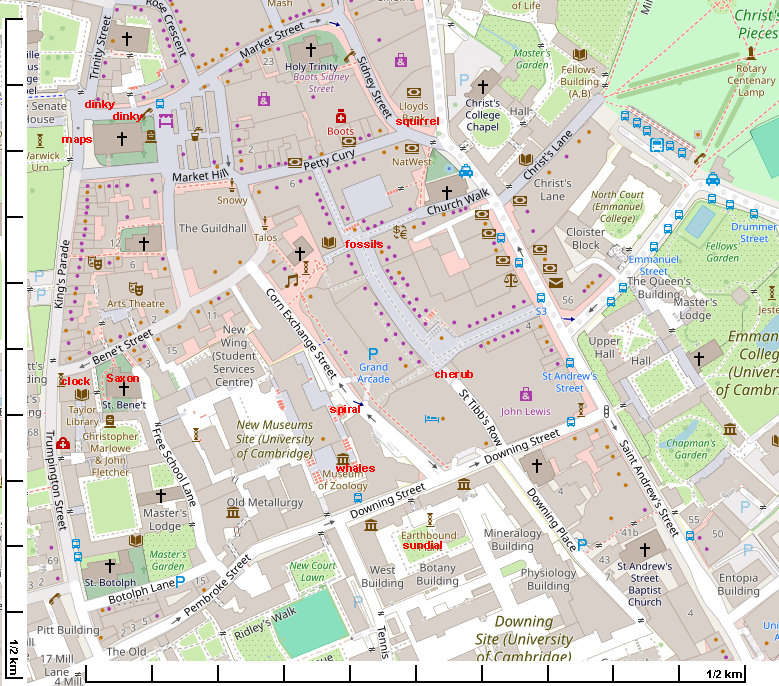
Here is the art not on the walk! You might like to look it out for yourself.
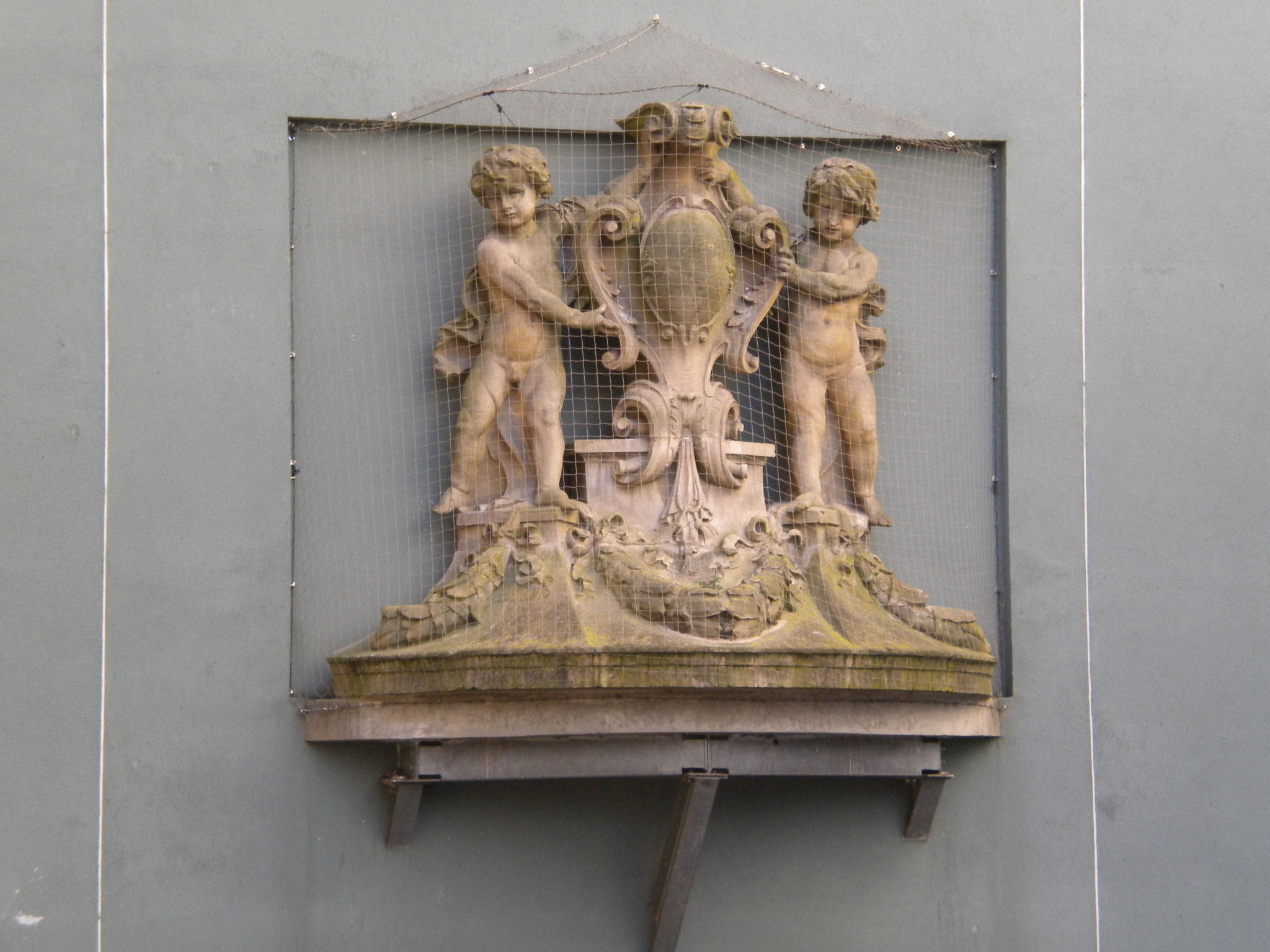
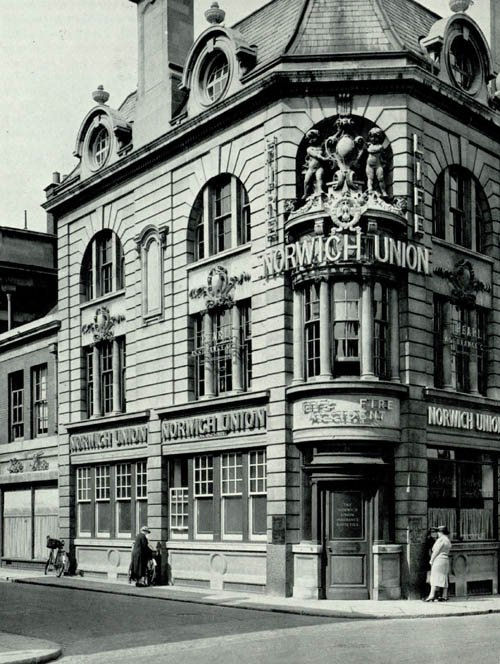
After turning into Downing Street from St Andrews Street, look down the road on the right. At the end, there is an ornate coat of arms with two supporting cherubs. This was originally on the Edwardian Norwich Union building, on the corner of Downing Street and St Andrews St. It gets moved around the place as buildings get built, and subsequently demolished! This website (under Development and Redevelopment) says "Another attractive Edwardian building on this site was destroyed to build the hideous Norwich Union building on the Downing Street/St.Tibbs Row corner - they preserved the statue of cherubs from over the door and it sat somewhat incongruously over the new entrance. This building was in turn demolished to build the Grand Arcade." At present, it is at the end of Tibbs Row, a small road off Downing Street, at the back of John Lewis, above a carpark entrance.
Nearby, on the lawn, there is a rather splendid sun dial. From sundial walk: "The rather battered sundial near the Downing Street entrance to the site is actually a collection of 17 dials all cut into a single block of stone. The sundial was presented by Professor Sir William Ridgeway (a famous archaeologist and classical scholar) and his wife Lucy in 1913. Their daughter, also named Lucy, married the son of John Venn (of diagrams fame). Sir William and (daughter) Lucy later set up the University's Ridgeway-Venn Travel Fund. According to University Ordinances, the first call on this Fund is for the maintenance of this sundial."

In Corn Exchange Street, there is a companion piece to Slate Work South (see above) called Slate Work East, made by the same artists. This one is a spiral, but rather hard to see, as it's tucked behind a staircase.

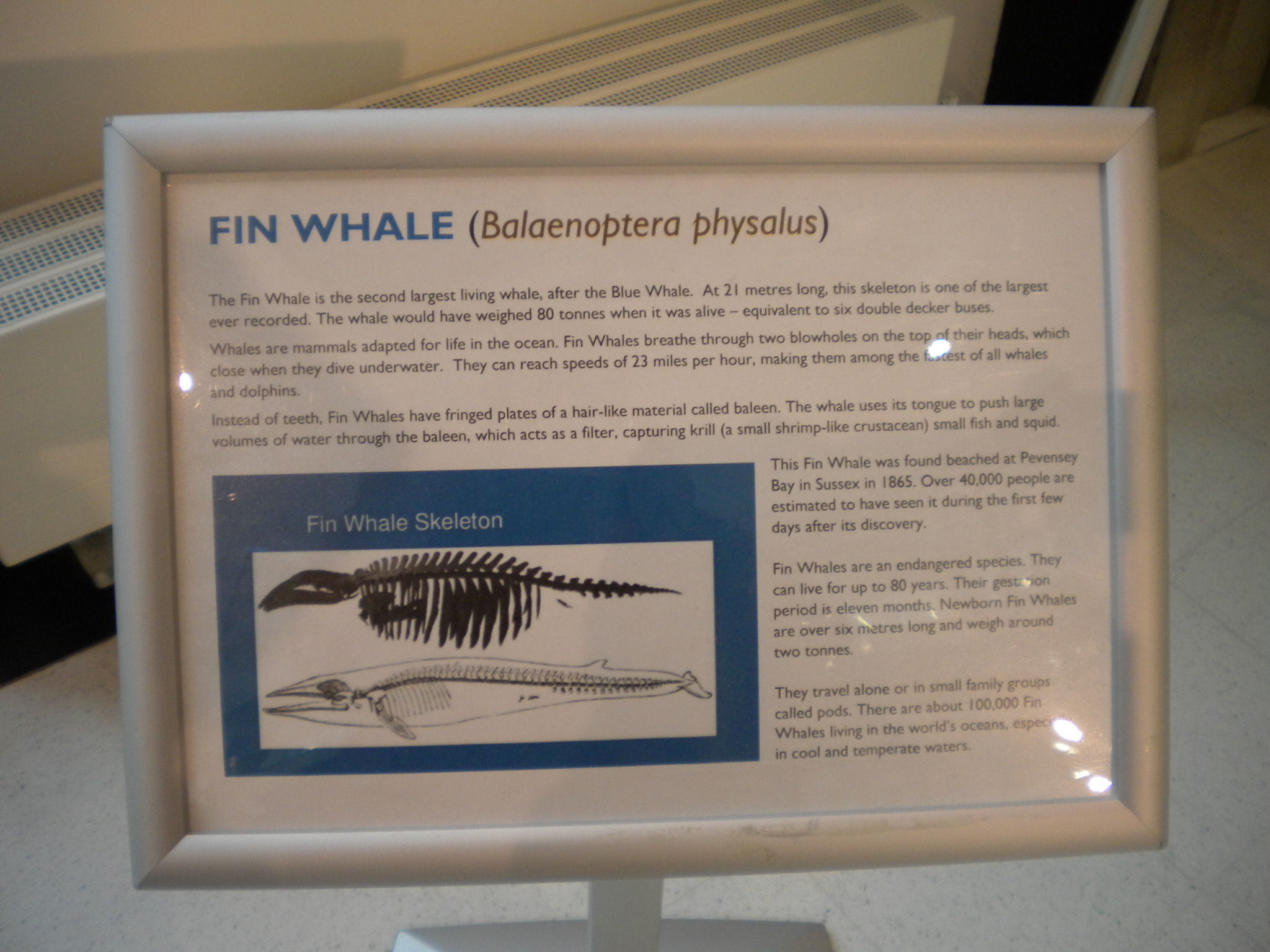
The Zoology Museum has a splendid Fin Whale in the entrance. You can see it even if the museum is closed. A notice describes how it got here: "This Fin whale was found beached at Pevensey Bay in Sussex in 1865. Over 40,000 people are estimated to have seen it during the first few days after its discovery." The skeleton has been on display here since 1996. I'm not sure whether this is art!

In the entrance lobby of the Zoology Museum, there is also a mechanical whale. This was installed in 2018. It was created by Matthew Lane Sanderson, with figures by Rachel Wood. It is a fantasy Zoological ariship representing a roving glocal centre for ecological scientific education, research and exhibition, a mirror of the Zoology Museum itself. The crew of the whale include; past and present eminent Professors of Zoology, a curator, technicians, young students and resident artists. You can turn a handle to make things move (you are invited to make a donation if you do.)

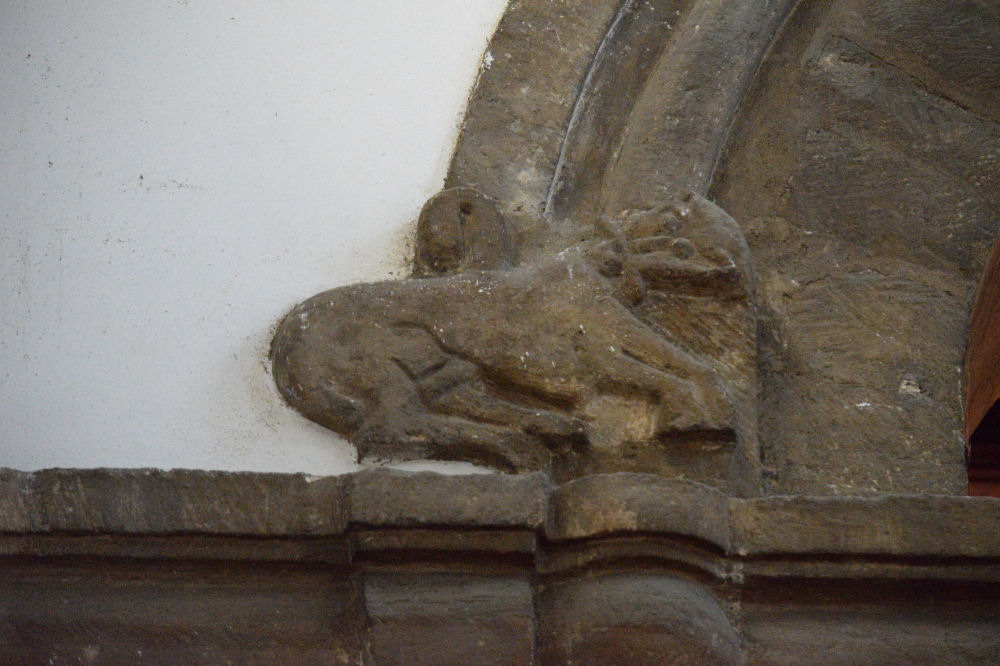
St Benets church, in Benet Street, is the oldest church in Cambridge. Its tower is Saxon (early 11th century AD). Inside the church (which is usually open), the tower arch has two interesting carvings of animals. These are also, presumably, Saxon.


On the corner of Benet Street and Kings Parade is a splendid clock called the Corpus Chronophage. The grasshopper is actually the world's largest grasshopper escapement. This rocks backwards and forwards, converting the pendulum motion into the rotational motion of the cogwheel. In this clock, this escapement is a ferocious insect with teeth that bite together every minute, eating the time. The creature's eyes blink at random.
A plaque close by says "The Corpus Clock, designed by John C Taylor and inaugurated in 2008 by Stephen Hawking, is accurate every 5 minures". Click here for John C Taylor's webpage.
The clock has no hands. There are three circles of dots which show the hour, minute and second. The clock seems to hestitate from time to time, which explains why the clock is accurate every five minutes rather than all the time.
The building housing the clock is now part of Corpus Christi college, but it used to be a bank. There are several carvings on it.

Outside Great St Mary's, there are two maps. Since these are 3D, they can be felt as well as looked at, so they can be used by the visually impaired. One map is of the city centre, and the other shows more of Cambridge. Click here for more details of this area.
There are inscriptions round the edge of one of them for the Golden Jubilee of Queen Elizabeth II in 2002, and the octocentenary of the City of Cambridge (its charter) in 2001.
The maps are made of bronze by Vernon McElroy and were installed in 2002. Vernon McElroy was a director of estate management at Cambridge University and a member of the Rotary Club of Cambridge Rutherford. He was a keen sculptor who designed and made these bronze tactile models. They were funded by Cambridge's four Rotary clubs.


Turn right after Great St Marys. There are two more Dinky Doors here.
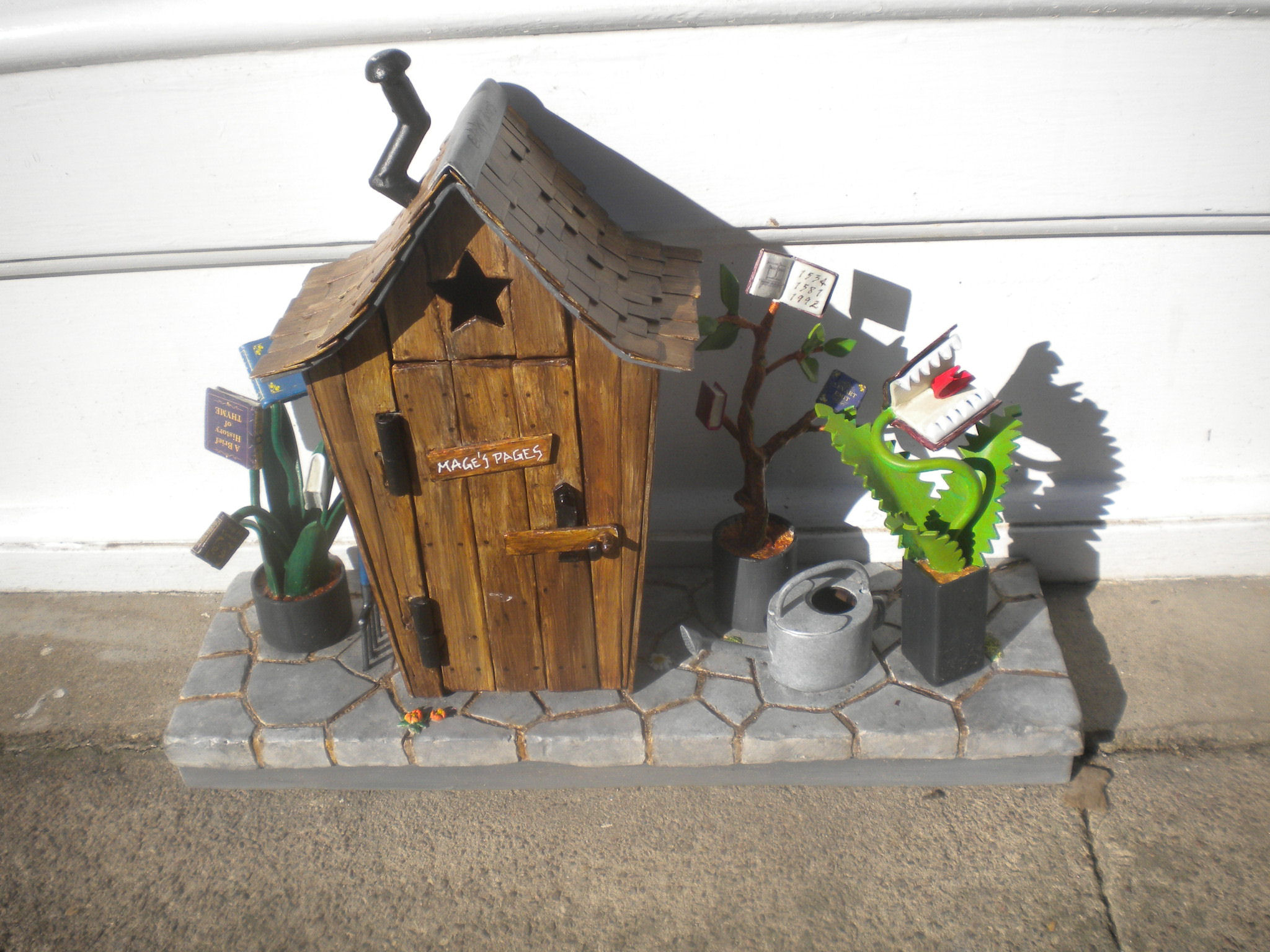
One is outside Cambridge University Press bookshop, opposite Great St Mary's. It shows books being grown (you say that you didn't know that was how they were made?)
The Books are:
A BRIEF HISTORY OF THYME - ref. Stephen Hawkins
AZ CENTRAL SPACE TIME - a necessary guide!
TOP TEN VOWELS
WART AND PEAS - ref. Tolstoy
LEVART EMIT - "time travel" backwards
An open book with a picture of a printing press and the dates 1534, 1581, 1992 - Cambridge University Press is the world's oldest publishing house, founded in 1534. There has been a bookshop on this site since 1581, which makes it England's longest continuously operating bookshop. But it only became the CUP bookshop in 1992.
POLY BIUS - The Dinky Door website says "Ignoring for the minute that Polybius was a Greek historian, it relates to an urban legend of a fictitious arcade game from 1981. The story tells of an unheard-of new arcade game appearing in several suburbs of Portland, Oregon, something of a rarity at the time. The game is described as proving popular to the point of addiction, with lines forming around the machines often resulting in fighting over who would play next. The legend describes how the machines were visited by men in black, who collected unknown data from the machines, allegedly testing responses to the game's psychoactive effects. Players supposedly suffered from a series of unpleasant side effects, including seizures, amnesia, insomnia, night terrors and hallucinations. Approximately one month after its supposed release in 1981, Polybius is said to have disappeared without a trace."
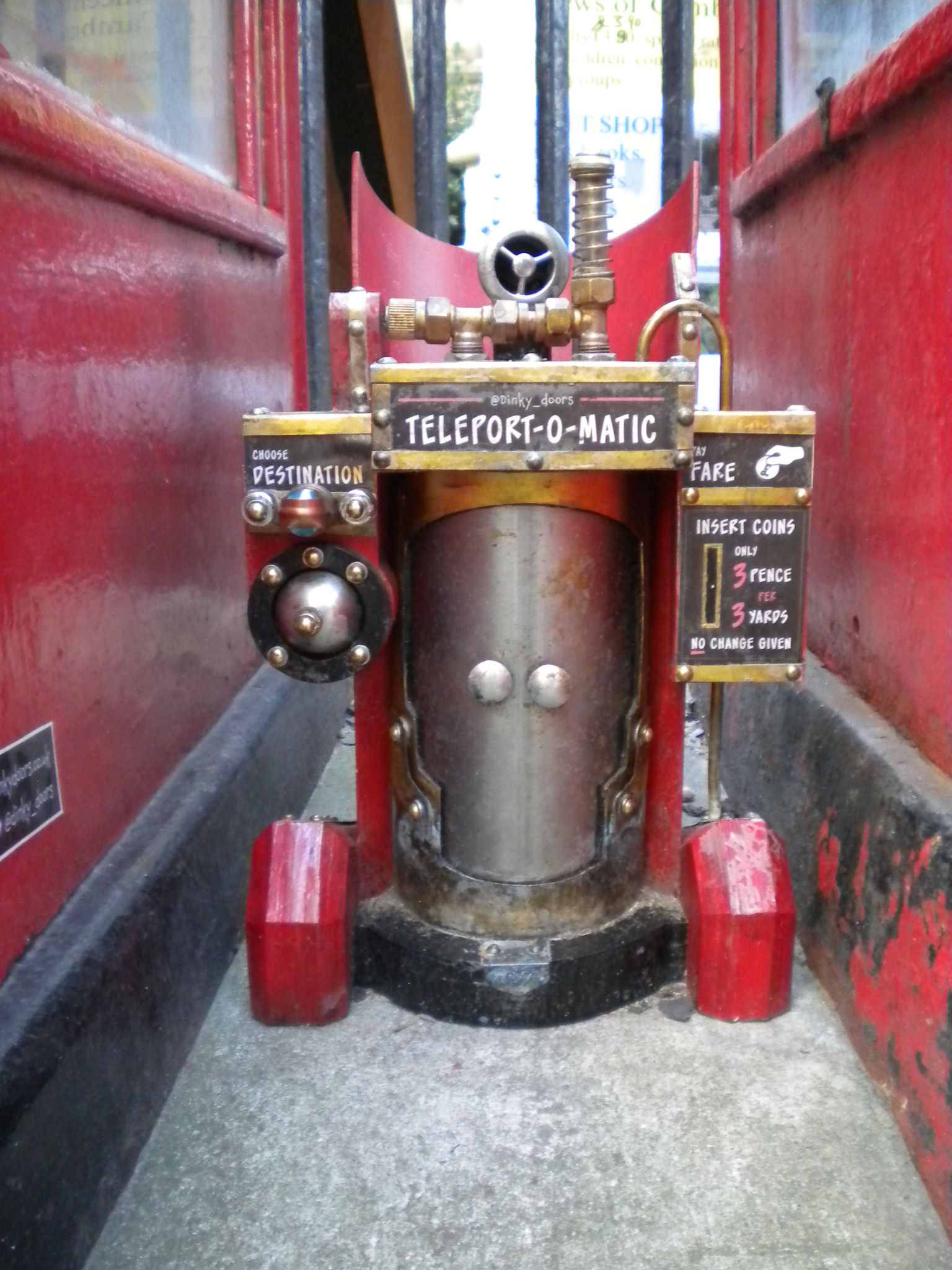
The other Dinky Door is between two phone boxes on the other side of the road. It's a Teleport-o-matic. The coin slot says "3 pence per 3 yards. No change given." It's ambiguous whether these are new pence or old pence. There is no 3p coin, although there used to be a 3d coin (old pence - it was called a thruppenny bit). Of course you could put in £3 and travel 300 yards!
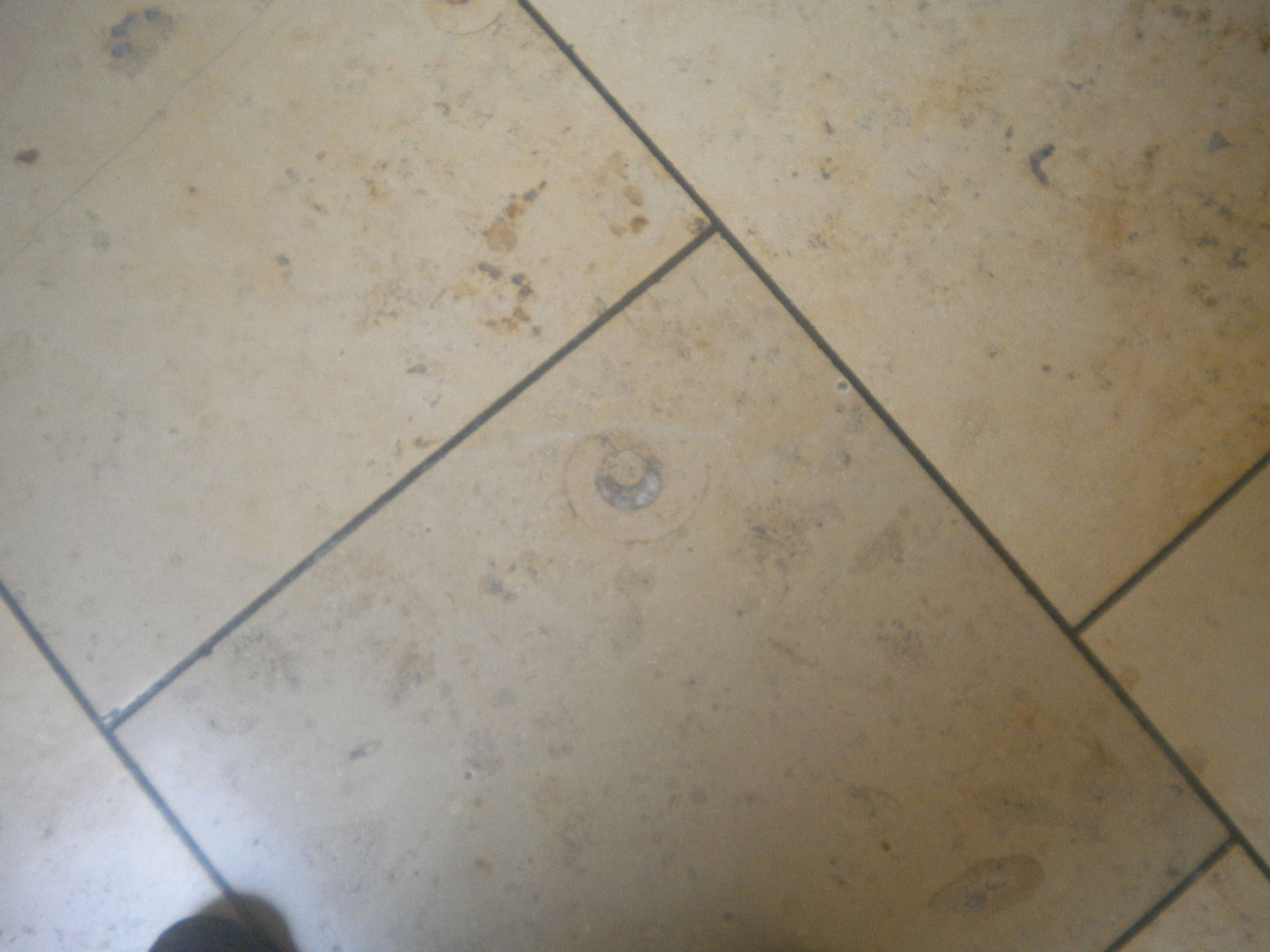
Walk through Lion Yard, but look down at the stone floor (such as in front of the escalator to the library) and you might see an ammonite! These fossils were part of the original stone. Are they artworks?
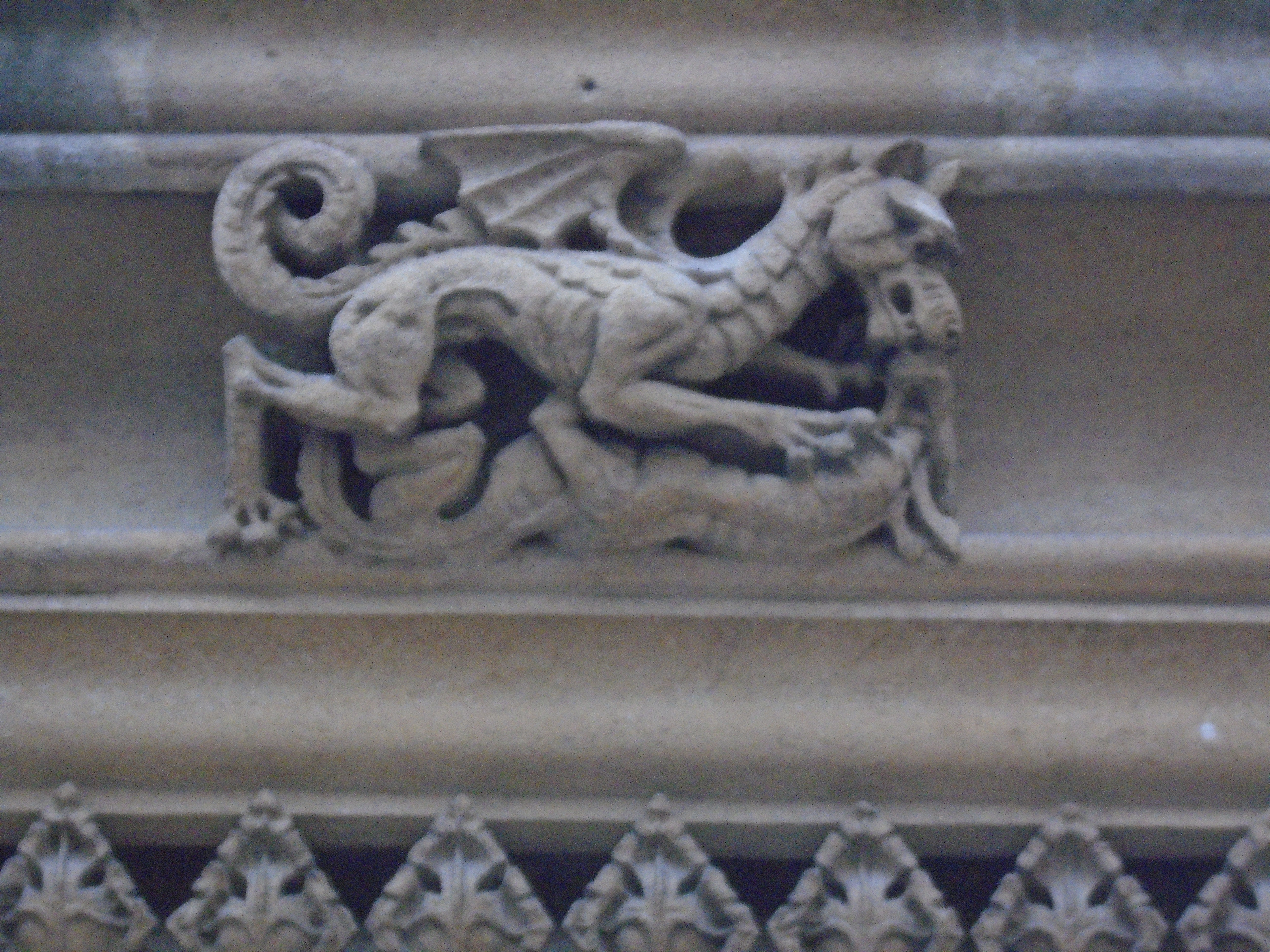
At the end of Petty Cury, in St Andrews Street, Lloyds bank has carvings, including some animals. One of them seems to be counting the money.


For other interesting things in Cambridge, try my Walks round Cambridge website, which covers other subjects as well.
I have indexed all the walks that I have done for the U3AC (including this one) here.
© Jo Edkins 2024 - Return to Walks index