
Battles involving England - War of the Roses
|
|
Battles involving England - War of the Roses |
|
Famous speeches by William Shakespeare about the War of the Roses
|
The Wars of the Roses was a dynastic battle between two noble families, Lanacaster, whose badge was a red rose, and York, with a badge of a white rose. They were fighting for the crown.Both these families were descended from Edward III. Henry IV, of the House of Lancaster, had seized the throne from Richard II. He and his son, Henry V were popular, but Henry V died quite young, and his son, Henry VI, became king when less than a year old. He lost all English lands in France, at the end of the Hundred Years War and generally, he was an unpopular king. He was challenged by Richard, Duke of York. Open fighting broke out in 1455 at the First Battle of St Albans. In 1459. York was forced to flee the country, but one of his most prominent supporters, the Earl of Warwick, invaded England from Calais and captured King Henry VI at the Battle of Northampton. York returned to the country and became Protector of England, but was dissuaded from claiming the throne. When York moved north to suppress the Lancastrian army, he was killed in battle at the end of 1460. The Lancastrian army advanced south and recaptured the hapless Henry at the Second Battle of St Albans, but failed to occupy London, and subsequently retreated to the north. York's eldest son was proclaimed King Edward IV. He gathered the Yorkist armies and won a crushing victory at the Battle of Towton early in 1461. Battle of Tewkesbury 1471 (location)Minor Lancastrian revolts were suppressed in 1464 and Henry was captured once again by the Yorkists. But Edward IV fell out with his chief supporter and advisor, the Earl of Warwick (known as the "Kingmaker"). Warwick the Kingmaker tried first to supplant Edward with his jealous younger brother George, Duke of Clarence, and then to restore Henry VI to the throne. This resulted in two years of rapid changes of fortune, before Edward IV once again won a complete victory in 1471 at the Battle of Tewkesbury. Warwick and the Lancastrian heir Edward, Prince of Wales died in battle and Henry was murdered immediately afterwards. This seemed to leave the Yorkists victorious. As Shakespeare makes Edward IV's brother Richard say "Now is the winter of our discontent made glorious summer by this sun of York". But Edward died suddenly in 1483. His son, Edward V was too young to reign, so Richard became Protector of England. Edward and his younger brother were lodged in the Tower of London, and never seen again. Richard III became king in 1483. | 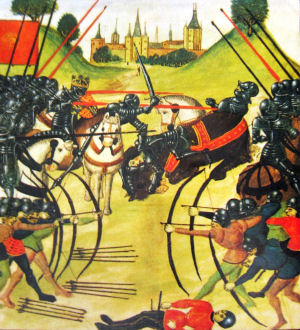 Battle of Tewkesbury, from a Ghent manuscript, late 15th century |
The dynastic war continued. Henry Tudor, a Lancastrian and another descendent from Edward III defeated Richard at the Battle of Bosworth Field. Richard was killed there, being the last king of England to die in battle. Henry VII became king. By this time, so many nobles had been killed that there were few contenders to the throne. Henry married Elizabeth of York, and made his badge the Tudor rose, with both red and white petals, to show that his dynasty combined both houses. There were still revolts, but he managed to defeat them.
From Richard III Act 2 Scene 1Edward IV is complaining that no-one stopped him ordering the execution of his brother Clarence.
|
From Richard III Act 5 Scene 4At the Battle of Bosworth. (Richmond is the future Henry VII.)
|
Wikipedia (external site) for further information - Battles index