
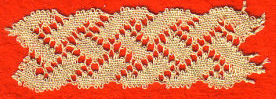
This is one of a series of experiments I did in designing Celtic knots. The first collection of patterns start with pattern 153, which were worked within footsides, in a conventional way. This pattern takes the Celtic knot right to the edge, so bits of the strands work almost like fans.
Pattern 157, pattern 158 and pattern 159 are variations on a theme.
Pattern:

Bobbins: 16 pairs
Style: Torchon
Stitches:
half stitch
cloth stitch
cloth stitch and twist
twist single pair (grey)
Details:
Torchon ground (grey)
cloth stitch zigzag (red)
chevron pointing upwards (red)
chevron pointing downwards (red)
cloth fans almost! (red)
Description:
Follow the links above for explanation of how to work the different parts of the lace. There are diagonals at the start, so I have marked false pins.
The centre of the knot is just cloth stitch strips. The start and end involves chevrons, pointing chevron pointing up or down. This is similar to the earlier Celtic knot patterns, starting with pattern 153. The difference here is that the edges of the Celtic knots are rather like cloth fans. There are differences, of course. There are no edges to the fans, as usual. Instead the workers go right to the edge of the shape, which is the strand heading to the edge, or leaving it. It is not hard to work, I assure you! What is like a fan is the shaping of the very edge of the lace - the normal bending outwards of the passives to make the curve.
There is no footside here, but the strands of the knot do not touch each other, so at one point, a pair of threads has to travel from one 'fan' to the next. Twist this pair twice (or more) times for strength.
Since the strands are close together, it can be hard to see the pattern of the knot. Try looking at it through half-closed eyes! Pattern 158 is a similar pattern with the strands further apart, which is, I think, better. But that needs more bobbins!
© Jo Edkins 2016 - return to lace index