
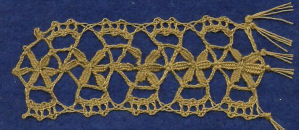
| Pattern: |
 |
Bobbins: 10 pairs
Style: Cluny
Stitches:
half stitch
cloth stitch
cloth stitch and twist
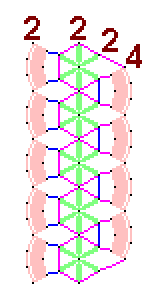
plait (pink and blue)
tally (green)
Details:
Cluny edge headside (red)
lazy join
Description: Click on the links above to see how to do the different parts of the lace.
It is important to work out the direction of the plaits and tallies. Two pairs on each side (making four pairs) stay in the headsides. Two pairs make the tallies down the centre, two petals per flower. Two pairs (maked as pink) make plaits which circle round flower of tallies, then join the headside on the right. These two pairs don't do any tallies at all. The remaining two pairs make the other four petals per flower - first the top two, right to left, then a plait (blue) to join the left headside, then another plait, then the bottom two petals of the flower, and finally a plait (blue) to get to the next flower. Here is a diagram demonstrating this:

After you have sorted out where everything goes, and what order to work each tally and plait (which is not always obvious!), you also need to do the joins. The two-way joins of plait and plait, or plait and tally, are simple lazy join. However, there are some three way joins, in the centre of the flower, and at top (or bottom) or the flower. I tied a couple of ways, and some of them didn't work! (See below). These three way joins are in two steps. You join, for example, two tallies. Two pairs get left alone for a bit, while the other two do the tally on the other side, plaits, headside, then finally return to do the second half of the join. The neatest result seemed to be when the first half of the join was a lazy join, using a pin. Then work two pairs until they return for the second half of the join. Take the pin out, and do another lazt join. It's still tricky, with threads tending to go where they shouldn't. Sometimes I tried taking the pin out yet again, and putting it where I could tighten the threads against. Sometimes just continuing with the lace, and tightening a couple of stitchs after the join helped the threads go back to the right place. Examples of lace in my collection in this style seemed to prefer the central two plaits to be plaits rather than tallies. This makes a four petalled flower rather than a six petalled one, which isn't as attractive, but it would make the central joins easier! Still, I did get some of the six petalled flowers to look OK.
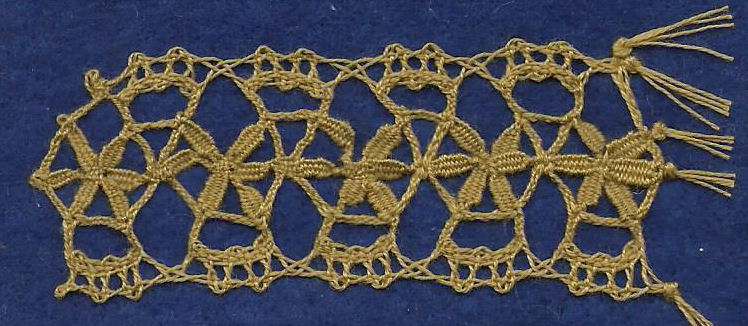
Close up of the lace, so you can see the working in more detail.
© Jo Edkins 2019 - return to lace index