
This pattern will only work with the right sized sticks. Please read Introduction to making a fan.

Pattern:
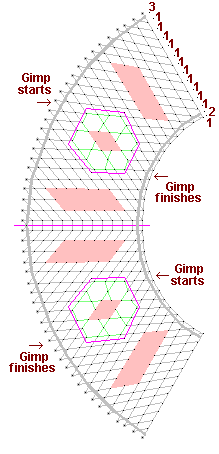
Bobbins: 17 pairs + 2 gimps (used twice)
Style: Bucks Point
Stitches:
half stitch and twist
twist both pairs
cloth stitch
cloth stitch and twist
twist pair
picot
gimp (pink)
Details:
picots and passives headside (grey)
cloth strip (red)
cloth diamond (red)
Bucks Point flower (green)
Bucks Point net (grey)
honeycomb (green)
cloth footside (grey)
making a fan
Description:
Follow the links above for explanation of how to work the different parts of the lace. The start is on a diagonal, so I have marked false starting pins.
The first fan that I designed was pattern 246, where the pattern was a simple strip, bent round into a curved shape - really part of a roundel. I wanted to explore different types of grid for fans, and here is an alternative way of making a design. It is based on a circular mat. These, despite being circular, are designed the same way as a square mat, made up of four quarters, each a triangle. The circular mats are made of quarters as well, but the triangles are distorted by the grid to have curves in, making the circular shape. The advantage of this type of grid is that the pin holes near the centre are not squashed together by the grid. To make this grid into a fan, I used only a third of the circle (120°) and removed the centre of the circle to make the fan shape.
You need to start working this fan at the top corner. The first half is a conventional Bucks Point design - follow the links above for details. Half way down, the threads simply travel downwards to the next pin (a twist or two is recommended for this). This is, believe it or not, equivalent to the 'corner' of a mat! Then carry on the rest of the pattern.
For this fan, I tried making my own fan sticks. I found a plastic folder at a stationery shop. It wasn't floppy plastic; it was quite stiff, but not too thick. I used a craft knife to (carefully!) cut several sticks of the right length. Then I stuck one stick to one end of the fan, and another stick to the other end. These sticks were stuck on different sides of the lace, and they overlapped at the bottom. Then I stuck some more sticks on at equal distances. All sticks except one were on the same side of the fan (the 'back' of the fan). I made a hole through all of the sticks at the bottom with a needle, then threaded through some thick thread, doubled up. This thread was then passed a couple of times through beads on either side (to make a 'stopper') and knotted off. This makes the hinge of the fan.
This is a miniature fan, not big enough to use. Since I made the fan sticks myself, I could make the fan whatever size I wanted. I also used thick thread, so I could increase the size of the pattern without increasing the number of bobbins. But I think that thinner thread might have been better. I suspect that the pattern isn't quite right for a fan, especially as the front stick covers part of the pattern, and you can see the sticks through the holes in the flower. Still, the principle works!
Fan stick length from hinge to end - 2.75 inches. Width of lace (max) - 1.25 inches.
© Jo Edkins 2017 - return to lace index