



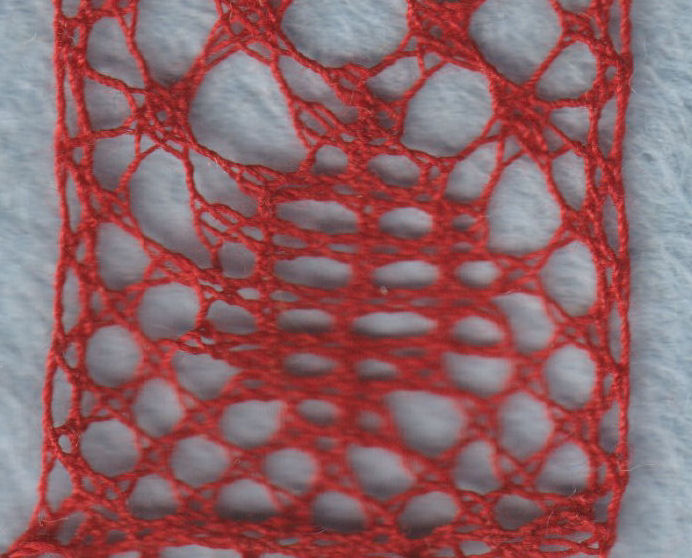
This is unashamedly experimental! I was trying to figure out what stitches were used in a photo of lace on the internet (see right). I did two pieces with different stitches. I do not recommend you do this pattern! But you might like to try some of the effects.
The pattern consists of diamonds and ground. It can be repeated as desired. I've given a small version.
Pattern:

Bobbins: 16 pairs
Style: Torchon (experimental)
Size: 9 inches long - 6.5 inches long
Stitches:
half stitch
cloth stitch and twist
cloth stitch
twist single pair
Details:
Torchon ground
twisted footside
Description:
Summary of my best efforts!

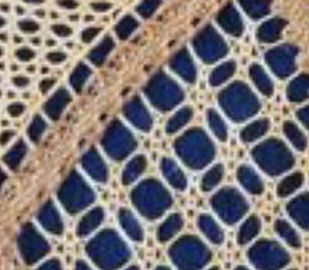
Bottom right ground: Middle two pairs do half stitch, pin (at top of centre). Then 2x2 half stitch spiders with about 3 twists between. Then pin (at bottom of centre), middle two pairs do half stitch. I'm calling this long spider ground.

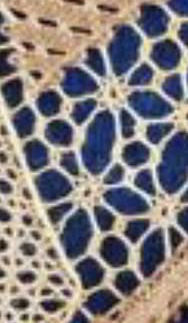
Top right ground: Star ground with a pin in the middle (which I don't normally do) and separated by twisting pairs. The units are separated by Torchon ground. I'm calling this star spiders.
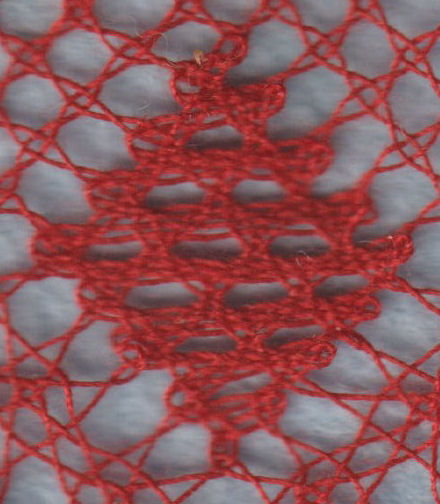

Top right solid area: This is described here. Two rows of cloth stitch, then two pairs are worked in cloth stitch and twist (i.e. there is no worker pair). You must kep an eye on which pairs are worked in cloth stitch and twist. They must give a diagonal pattern, so the pairs must be different from the previous one. That means that a pair (or two) may not be involved. I just twisted those. Only criticism is that I think I should have twisted all pairs before doing the cloth stitch and twist.
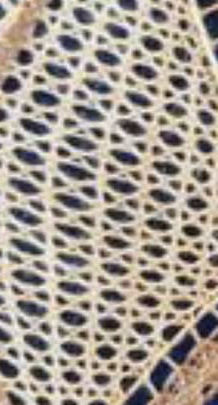
I give up, with this one!
Bottom right ground

The basic unit is 2x2. They are next to each other, without ground to separate them. Some have pin holes at corners, and some in the middle.
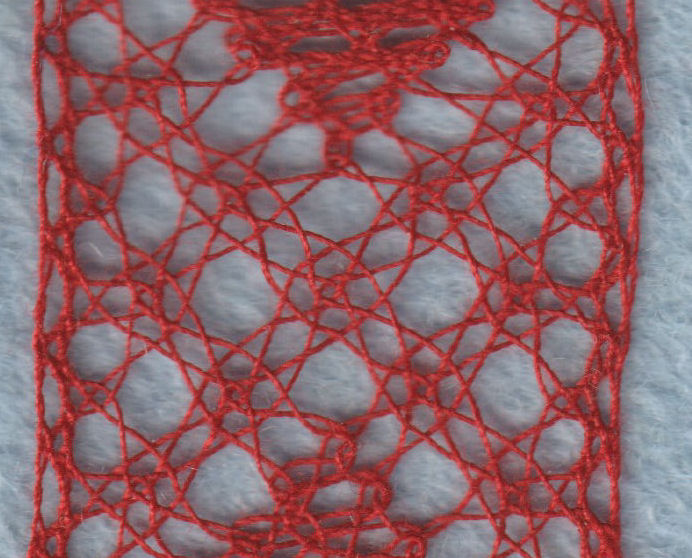
2x2 half stitch spiders without twists between. No.
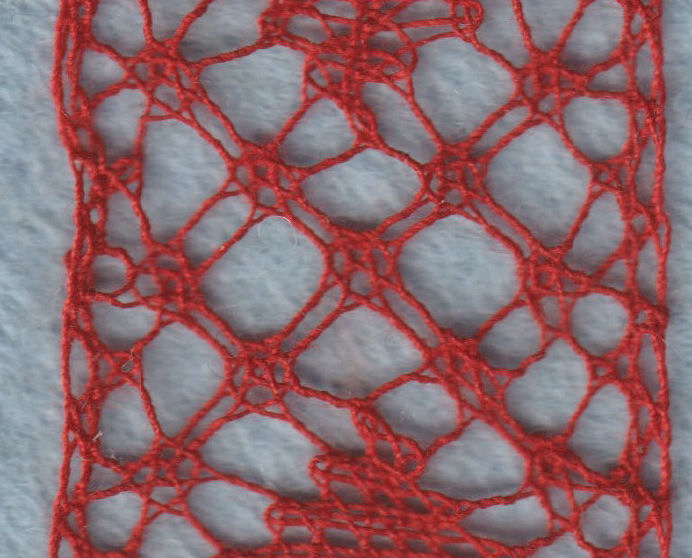
2x2 half stitch spiders with about 3 twists between. Quite good, but the original seems to be longer vertically than horizontally.
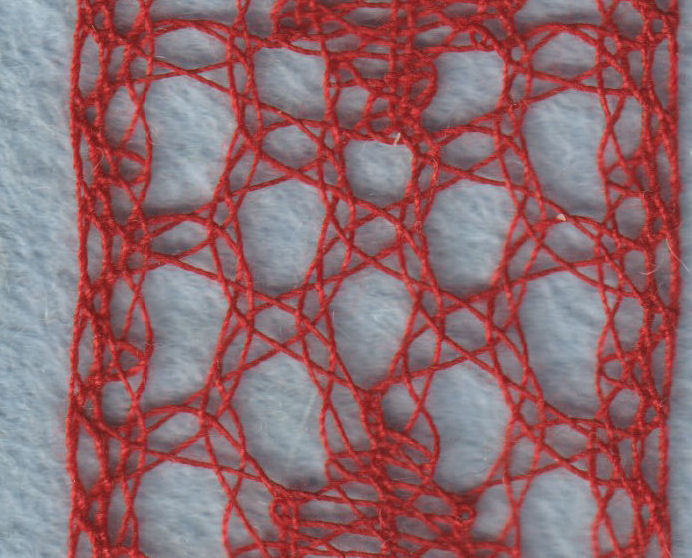
Rose ground, but done with half stitch rather than cloth stitch and twist (or half stitch, pin, half stitch) for all stitches. Rather pretty! Not done this before... But not like the ground I was looking for.
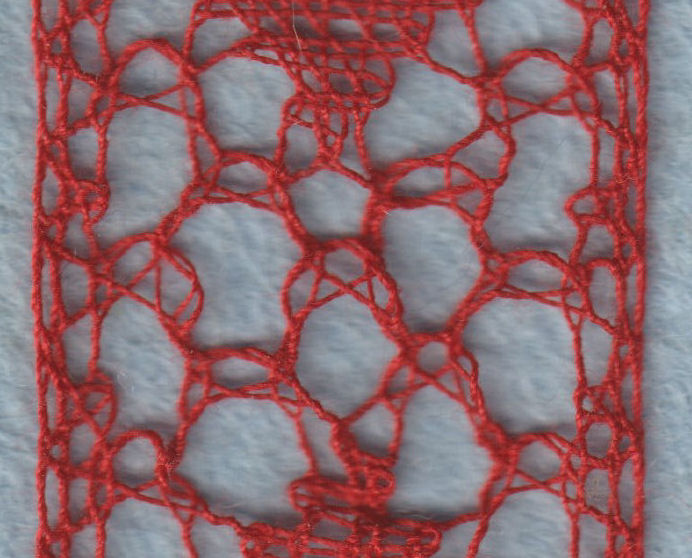
As above (a half stitch rose ground) but separated with twists. The problem is that the two pairs on each side don't get separated. No.
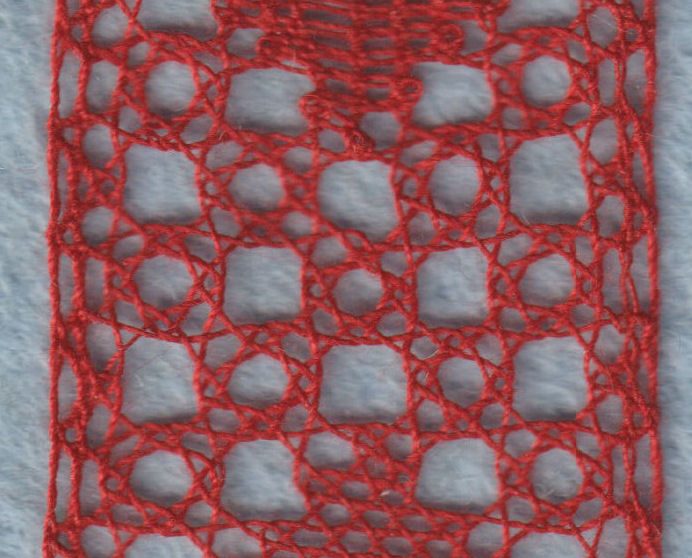
Rose ground, with half stitch crossovers. (I was starting to get interested in different types of rose ground - See pattern 588 for where that led.) But again, the two pairs are too close.
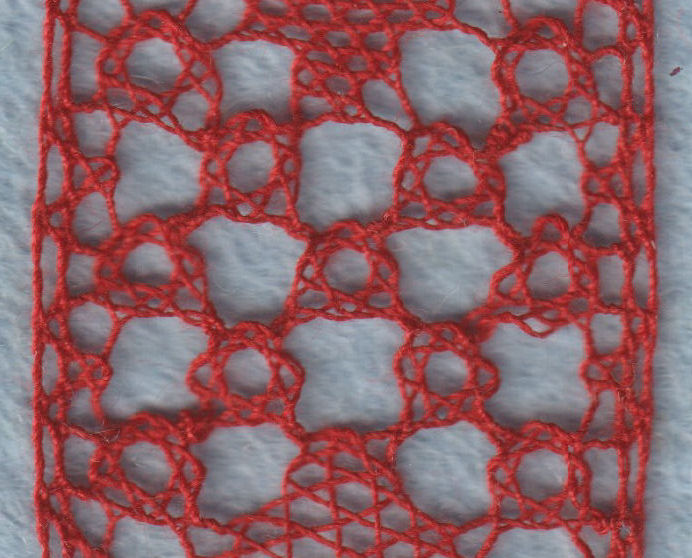
Rose ground, with half stitch crossovers separated by twisting all pairs several times. Rather a mess.
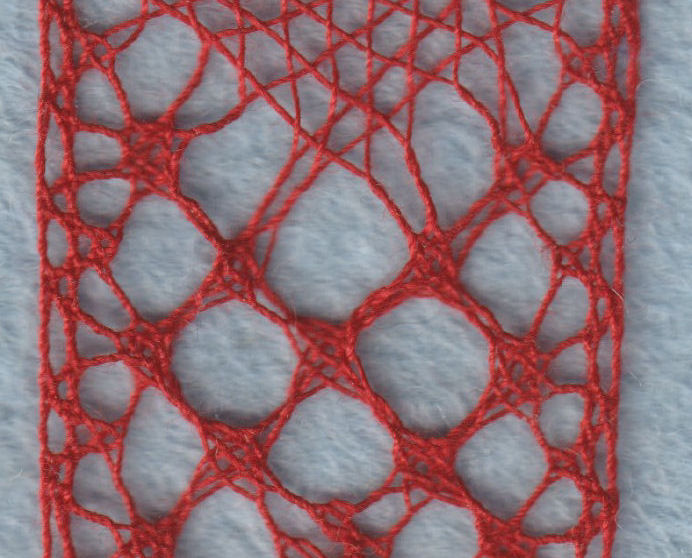
Star ground with a pin in the middle (which I don't normally do) and separated by twisting pairs. Normally star ground is separated by lines of Torchon ground, and this shows why! The two pairs are too close together.

Flemish ground It's a bit like rose ground, except two two pin holes (top and bottom) and uses half stitch everywhere else. Like rose ground, the two pairs on each side are too close together, but you do get the vertical effect a bit.

Flemish ground with twists between. No.
Middle two pairs do half stitch, pin (at top of centre). Then 2x2 half stitch spiders with about 3 twists between. Then pin (at bottom of centre), middle two pairs do half stitch. I think this might be it!
Top right ground

The basic unit is 2x2. They have ground to separate them. The original used double Torchon, but I use Torchon ground. Some have pin holes at corners, and some in the middle.
Star ground with a pin in the middle (which I don't normally do) and separated by twisting pairs. The units are separated by Torchon ground. This is a distinct possibility..... I'm calling this star spider.

2x2 half stitch spiders with about 3 twists between. This isn't too bad, but I think that the star ground above is better.
Top right solid area
This is described here. Two rows of cloth stitch, then two pairs are worked in cloth stitch and twist (i.e. there is no worker pair). I think I've got this one right! You must kep an eye on which pairs are worked in cloth stitch and twist. They must give a diagonal pattern, so the pairs must be different from the previous one. That means that a pair (or two) may not be involved. I just twisted those. Only criticism is that I think I should have twisted all pairs before doing the cloth stitch and twist.


I wondered if the rows were too squashed together, so tried not doing all the rows. But it led to a problem as to what to do with pairs coming into the empty rows. And it's a bit sparse.
Left solid area
This was the tricky one! I don't think I got it. A conventional half stitch diamond has a single thread going horizontally along the row. This one has vertical lines instead.
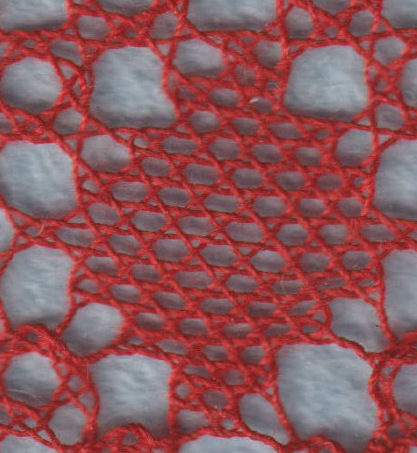
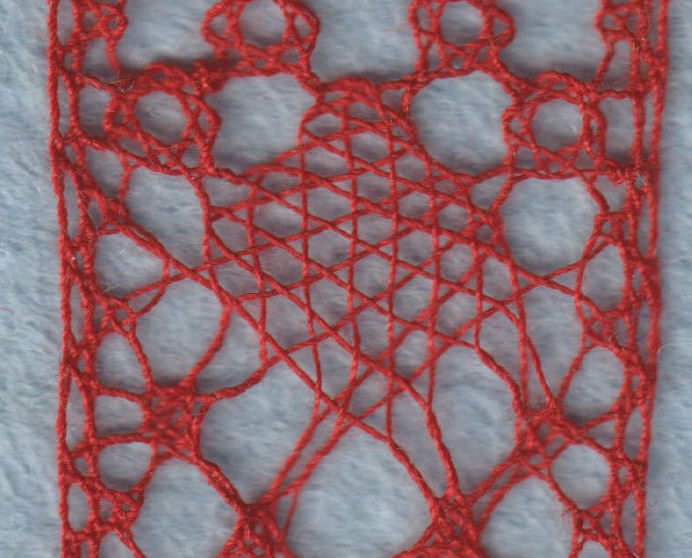
Gravenmoer diamond - like a half stitch diamond, but there are vertical threads as opposed to horizontal ones. I thought this was it, orginally, but definitely not.

Kat stitch. No.

Kat stitch, but using half stitch rather than cloth stitch and twist. I wondered what it would do... Not worth it!

Lattice stitch. No.
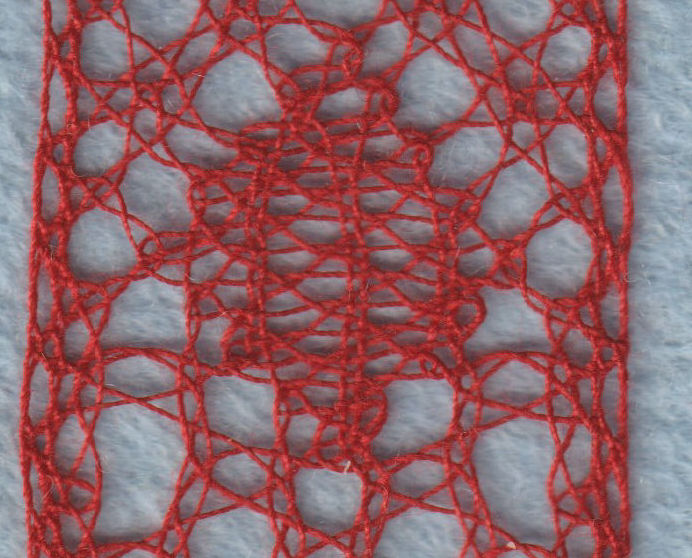
Alternately cloth stitch and half stitch across each row, lined up. NOt very pretty and not like the original.
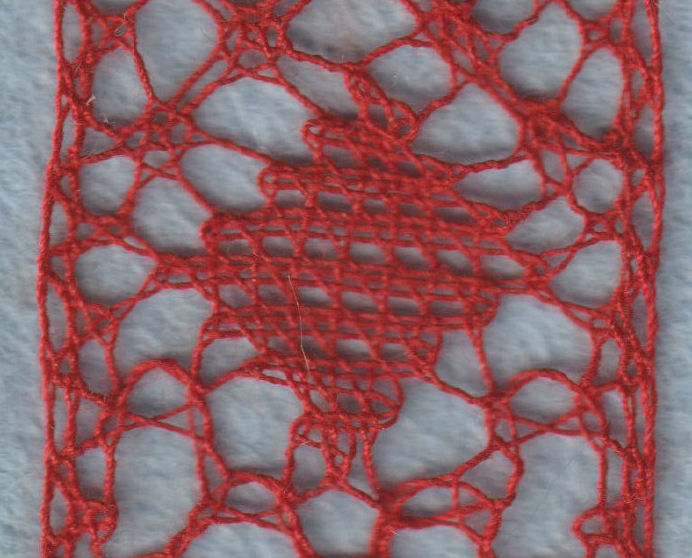
Row of cloth stitch, then row of half stitch, and so on. Nothing like the original, and a bit as if I'd done a row of cloth stitch then twisted every pair (see next).
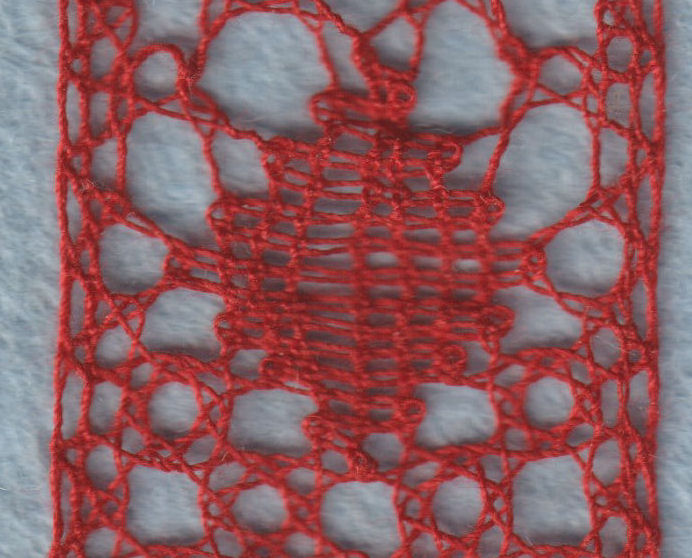
Row of cloth stitch, then twist all pairs (see previous). No, it looks different.
Two rows of half stitch, then every two pairs worked in cloth stitch and twist. Rather like stripey diamond, but in half stitch rather than cloth stitch. And lining up the cloth stitch and twist vertically rather than diagonally. Possibly....

Same as previous, but not using every line. Got into a bit of a mess with this one....
Close up of the lace, so you can see the working in more detail.


© Jo Edkins 2026 - return to lace index