
In these examples, the lace tends to be worked in a direction, downwards. The straight edge of lace is called the footside, and if present, it will be on the right. The wavy or frilly edge is called the headside, and if present, it will be on the left.
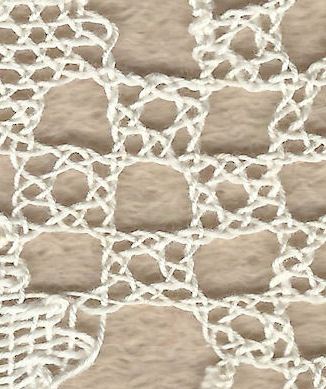 |
Rose ground is used in Torchon style of lace, and elsewhere. It has a distinctive look. There is a checkerboard design of holes and lace. The lace is worked round a group of four pins, which creates a diamond of four holes. There is a bigger hole in the centre. In fact, another name for rose ground is Cinq trous (five hole). The technical description of rose ground is quite complicated. The 'corners' are CTCT, or cross, twist, cross, twist. In this example, each pin is worked CT, pin, CT, or cross, twist, pin, cross, twist. Click here for a description of how rose ground is done, with an animation. Click here for the whole piece of lace. |
|
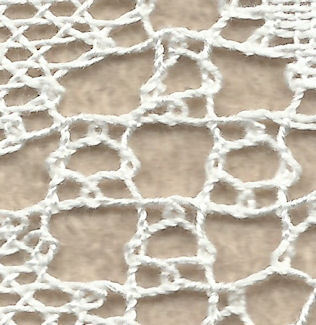
Rose ground may be worked in different ways, using more or less cross, twist at the corners, and at each pin. This produces different effects (see left and right), but there is still the checkerboard of holes and lace, plus the pattern of five small holes within each design. Click here for the whole piece of lace (left). Click here for the whole piece of lace(right). |

|
Machine lace manages to reproduce the checkerground of holes and lace, and the central hole. However, the four pinholes are usually missing, and the threads look coggled, with their path unclear, and certainly non-standard.
|
Click here for the whole piece of lace.  |
Click here for the whole piece of lace. 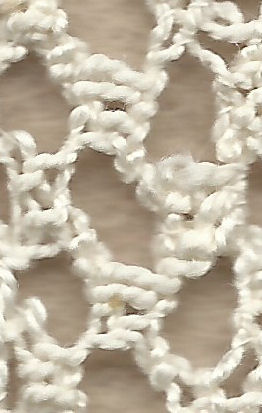
|
Click here for the whole piece of lace. 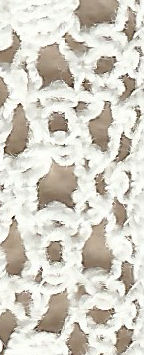
|
Return to Lace Collection index
© Jo Edkins 2014